
Today's Contents
Reporter's Notepad:
- Ukraine's FortuneGuard in talks to raise $50 million and take AI-based war-risk insurance solution to new markets
Just The Facts:
- Russia says it won't relinquish control of Zaporizhzhia nuclear plant
- EU says 'unconditional withdrawal' from Ukraine is precondition for change to sanctions on Russia
- Dragon Capital to invest $100 million in Ukraine this year, CEO says
- Ukrainian agriculture ministry to build modern vegetable storage facilities in frontline areas with FAO backing
- Norway grants additional €139 million to Ukraine's Naftogaz through EBRD
- Ukraine sets minimum sale price of state-owned Sumykhimprom at $29 million, Ukrbud at $6.3 million
- EBRD approves €15 million risk sharing facility to back Ukrsibbank's €30 million in loans for Ukrainian businesses
Here's What They Think:
- Responsible Statecraft: Europe needs sober debate on peace in Ukraine, should focus on rebuilding
- Atlantic Council: Trump needs to put more pressure on Moscow for true peace in Ukraine
Sober Second Thought:
- Ukraine's anti-corruption enforcement system shows 'impressive' results, but more progress needed, report says
The Rebuilders' Social
- Social media posts about a "de facto woodworking blockade" at the Polish border, logistics improvements needed, the Ukraine Facility audit board, the Forvis Mazars XFactory Ukraine, and more.

Dear subscribers,
News stories often miss the nuance and detail of traditional storytelling. Such is the case with the exclusive news story we bring you about Ukrainian InsureTech firm FortuneGuard and its founder Oleksii Omelianchuk, a former fashion entrepreneur,
Oleksii, who seems to fit the profile of an excited, perhaps slightly distracted, startup genius, now aims for major expansion in the war-risk insurance sector.
Just as interesting, perhaps, is the origin of the story - the idea to create FortuneGuard, which has now partnered in Ukraine with ARX and McGill and Partners, came to him when his own business was ruined by the war.
Love&Live, a successful online fashion business, saw 95% of its revenue wiped out by the Russian invasion, and even the physical premises of some providers was destroyed.
Oleksii's decision among the ruins to create FortuneGuard propelled him on a journey into the heart of the global insurance industry, through the Lloyd's Lab InsureTech accelerator and into the inner works of an industry that has changed little in decades.
The possible narrative arch could not offer a better Made in Ukraine story - from a fashion business gutted by the Russian invasion to a global war-risk insurance giant (fingers crossed). The story's got tech, it's got disruption, and it's got Build Back Better and reconstruction in spades.
That story, though, is for another time.
With our shield of journalistic neutrality again raised, we offer you the hard news story that came out of the interview:
Ukraine's FortuneGuard in talks to raise $50 million to expand AI-based war-risk insurance solution
FortuneGuard, a Ukrainian InsureTech startup that has developed an AI-powered war risk insurance solution for Ukraine, is now in talks to raise capital and take the model to new markets and product lines.
The solution, launched in partnership with UK reinsurance broker McGill and Partners and ARX Insurance, a Ukrainian subsidiary of Canadian insurer Fairfax Group, has been used since January to quote $2 billion in coverage for warehouses, shopping centers, and other assets in Ukraine, with capacity provided by Lloyd’s of London and other London market insurers.
“We have an innovative thing going on but we feel it’s still in a nascent form and we want to develop it much further,” FortuneGuard founder and CEO Oleksii Omelianchuk told Ukraine Rebuild Newswire. “Political violence and war risks are becoming much more prevalent across the globe — turbulence is going to be increasing in many regions.”
Omelianchuk said he aims to raise capital to expand the solution and take it to new geographic areas and business lines, and has already met with institutional investors and development finance institutions.
“We’ve had strong expressions of interest,” he said. “We’re now in conversations with potential strategic leads to anchor the round, and several institutions have indicated they’re ready to follow once that’s in place."
The fundraising target is aimed at enabling FortuneGuard to grow its product and operations. “We want to set up operations in Europe and the US. We want to take up several lines of business. We want to lead the markets globally in political violence and war, obviously.”
“There’s a lot of money needed related to compliance, and of course, developing the tech. But mostly it’s people — you have to have a very serious operational team for this and a serious board and all of that. So we’re going to be shooting for high numbers.”
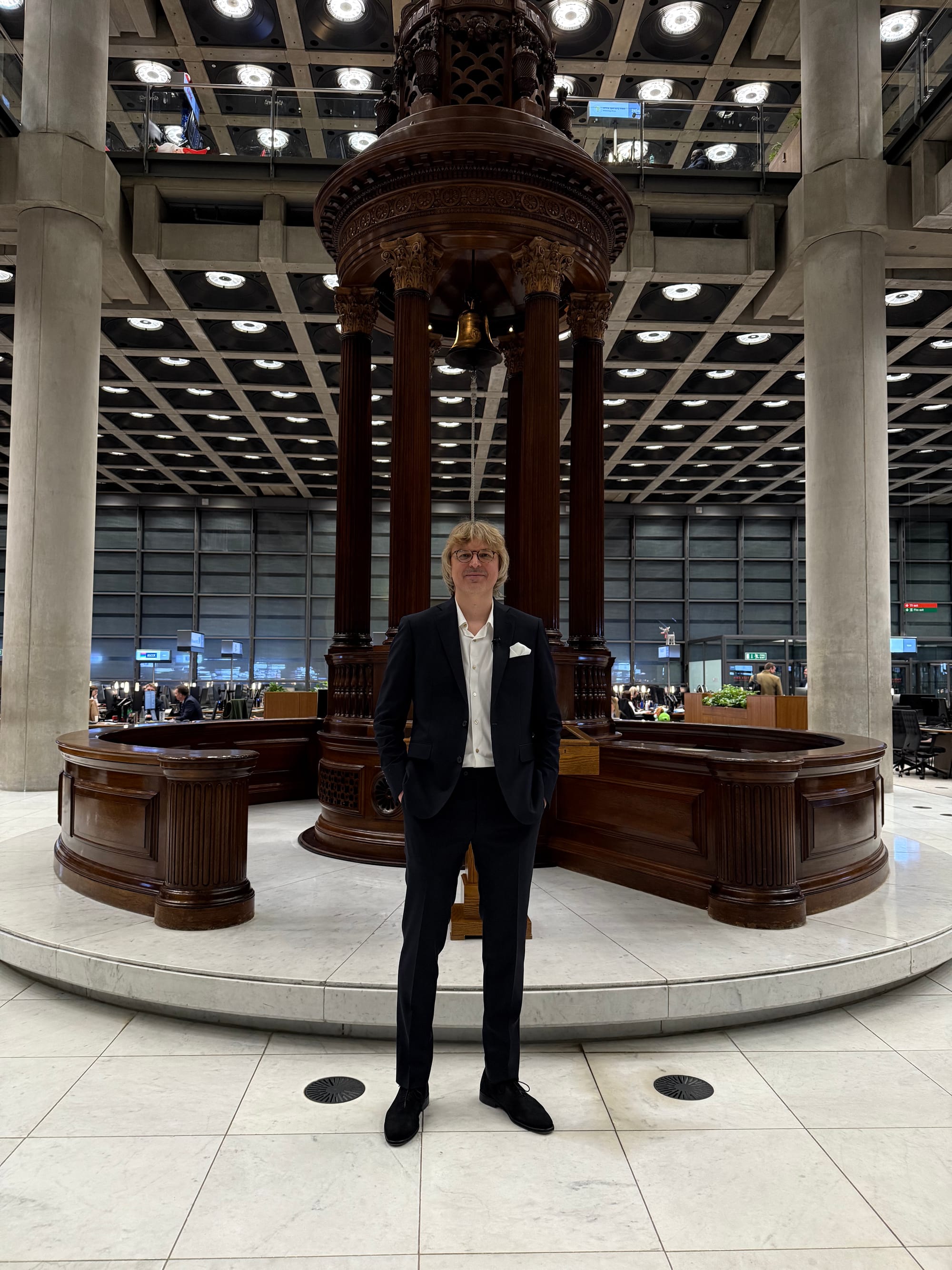
The startup last year passed through the Lloyd’s Lab InsureTech accelerator, and “they invited us to become a Lloyd’s broker,” Omelianchuk said. “Broker status is the easiest way to access other markets, because Lloyd’s has lots of licenses globally, and if you’re a registered Lloyd broker, you can immediately operate in those markets and deploy products.”
His solution, he said, allows the company to quickly process information such as government data on the density and frequency of missile and drone strikes, the severity of the damage, the kinds of assets hit, the types of industries affected, along with large volumes of open source data and use it in complex insurance calculations.
“If we were to do it manually, it would take a very long time,” he said. “But now we can do pricing in seconds — pricing with various limits, with various deductibles, various other parameters, based on risk scores.”
FortuneGuard’s solution has been used since January to analyze $3 billion in insurance requests for assets in Ukraine, and has resulted in quotes on $2 billion worth of coverage, rejecting about a third, he said.
“It allows the providers to see the risks clearly in a differentiated form, so it reduces their risks,” said Omelianchuk. “We have, for example, declined a lot of assets in Ukraine which otherwise could be insured. This is good for the clients too because it reduces the risks for the providers and the lower the risk, the lower the price you pay for that policy.”
The highest quoted limit on a single asset so far was $30 million, although they are prepared to offer coverage of up to $50 million, he said. As for pricing, he said, “we have been able to quote around 2.5%."
In other words, insuring a warehouse for $10 million against missile strikes and other war risks would cost around $250,000 a year.
The assets that can be covered also include shopping centers, solar power parks, factories and even equity in a local company, said Omelianchuk, who founded FortuneGuard after his first business, online fashion retailer Love&Live, was virtually destroyed in the 2022 invasion.
“We have telecoms wanting to insure their equipment and buildings,” he said. “We can also insure equity investments. If an investor is putting money into a new project — maybe $10 million and the project is worth $30 million — we can insure those $10 million.”
For questions related to daily news, story suggestions, scoops and other newsy matters, please message URN newsroom chief Valentina Bajic at valentina@ukrainerebuildnews.com.
For sponsorships, the URN Guidebooks, the Tips for Investors column and other general matters, email founder Adam Brown at adam.brown@ukrainerebuildnews.com.
If in doubt, email us both and we'll sort it out.
Now, on with the day's headlines ...

Russia says it won't relinquish control of Zaporizhzhia nuclear plant
The Zaporizhzhia nuclear plant, located 650 kms southeast of Kyiv along the Dnipro River, is "under Russian jurisdiction" and will not be handed over to Ukraine, the US, or international organizations, Russia's foreign ministry said.
The ministry said that joint operation of the facility with another state "is not acceptable" as "it would be impossible to properly ensure nuclear and physical nuclear safety and settle issues of civil liability for nuclear damage." It added that a potential cooperation with an international organization to run the plant "seems absurd."
"The return of the plant to the Russian nuclear industry is a long-established fact that the international community only needs to recognise," the Russian ministry said on Tuesday. "The transfer of the ZNPP itself or control over it to Ukraine or any other country is impossible."
The Zaporizhzhia region, partially occupied by Russian forces, was one of four Ukrainian territories annexed by Russia following referendums staged after Moscow's full-scale invasion. A presidential decree subsequently declared the power plant Russian property.
Western countries, however, have rejected the referendums as illegitimate.
Earlier this month, during a phone call with Ukraine's President Volodymyr Zelensky, US President Donald Trump discussed Ukraine's electrical supply and nuclear power plants, saying that the US could help run those plants with its electricity and utility expertise.
Zelensky confirmed to the Financial Times during an online briefing that his discussions with Trump focused solely on the Zaporizhzhia nuclear power plant.
All six of the plant's reactors remain in cold shutdown mode.
EU says 'unconditional withdrawal' from Ukraine is precondition for change to sanctions on Russia
The unconditional withdrawal of Russian forces from Ukraine would be a key condition for any changes to sanctions, the European Commission told Reuters
"The end of the Russian unprovoked and unjustified aggression in Ukraine and unconditional withdrawal of all Russian military forces from the entire territory of Ukraine would be one of the main preconditions to amend or lift sanctions," said Anitta Hipper, EU spokeswoman for foreign affairs and security policy.
While the EU does not impose sanctions on agricultural goods, it has introduced "prohibitive tariffs" on grain products imported from Russia and Belarus, effective since July 1, according to the report. Discussions are ongoing regarding additional tariffs on other agricultural products and certain fertilizers.
EU member states renewed the bloc's two sanctions frameworks on Russia for another six months at the end of January and earlier this month.
"Russia must now demonstrate genuine political will to end its illegal and unprovoked war of aggression," Hipper said. "Experience has shown that Russia must be judged by its actions, not its words."
The statement follows comments from the Kremlin that the US-brokered deal with Russia and Ukraine for a ceasefire in the Black Sea would not enter into force until a sanctioned Russian state bank was reconnected to the international payment system, according to a separate Reuters report.
Ukraine and Russia also accused each other of violating the truce on energy strikes.
"Launching such large-scale attacks after ceasefire negotiations is a clear signal to the whole world that Moscow is not going to pursue real peace," President Volodymyr Zelensky wrote on X, after Ukraine's military reported 117 Russian drone attacks overnight.
Dragon Capital to invest $100 million in Ukraine this year, CEO says
Dragon Capital plans to invest $100 million in Ukraine this year due to improved macroeconomic predictability and economic growth in the country, CEO Tomáš Fiala said at a conference in Kyiv organized by the think tank We Build Ukraine.
Fiala said most of the funding will come from Dragon Capital's own funds and shareholder capital from co-investors, with up to a quarter of it being borrowed.
"We truly believe that 2025 will be the first year during the war when we have much better macroeconomic predictability," he said, as reported by The Odessa Journal. He noted that Ukraine has already secured commitments to finance its 2025 budget deficit and "almost all" of 2026.
Ukraine has secured $56 billion in confirmed financing, exceeding the $40 billion required to cover the 2025 budget deficit, Fiala said. "That is if there is no ceasefire, but if it happens, about $10 billion less will be needed," he explained.
"We are not the only ones paying attention to ceasefire negotiations. You can look at this 'barometer'—the prices of Ukrainian Eurobonds traded in London. These represent assessments by dozens of foreign investors regarding Ukraine's risks," he said.
"Eurobond prices have been rising for the past two years, but this growth has accelerated since about October last year," he added.
New investors gauge Ukrainian risk through sovereign Eurobonds, aiming for yields of 13-14% annually—the rate at which they are willing to purchase Ukraine's government debt, according to Fiala.
Between 2015 and 2021, the Ukrainian investment firm invested $700 million in Ukraine, with about a third of the investments being debt-financed. Approximately 80% of these investments have already been repaid.
Dragon Capital said earlier this week it has started the construction of a residential complex in Sokilnyky village, near Lviv, marking its first investment in the western Ukrainian city's residential real estate sector.
Ukrainian agriculture ministry to build modern vegetable storage facilities in frontline areas with FAO backing
Ukraine's agriculture ministry said it plans to build modern vegetable storage facilities in frontline regions of Mykolaiv and Kherson to help farmers preserve their harvests.
"The development of a vegetable storage system will contribute to the development of small businesses and ensure the sustainability of rural areas," Ukraine's Minister for Agrarian Policy and Food Vitaliy Koval said.
"That is why we are now launching an active project to build vegetable storage facilities. Small vegetable storages–from 20 tons to 1000 tons–would help the farmer preserve his goods and hold them until the best price," he added.
"Large ones–for 2,000 tons or more– can be used by both farmers and companies that buy food for universities, hospitals and supermarkets. This approach will allow us to create the first farmers' cooperative on this basis,” he added in a press release accompanying his meeting with representatives of the UN's
Food and Agriculture Organization (FAO).
The minister also highlighted a joint project with the FAO to generate electricity from agrobiomass, strengthening energy security and sustainability. "The development of bioenergy is not only energy independence, but also an opportunity for additional income for farmers," Koval said via Telegram.
Norway grants additional €139 million to Ukraine's Naftogaz through EBRD
Norway will this year provide a total of €139 million in grants to Ukrainian oil and gas company Naftogaz to facilitate loans extended by the European Bank for Reconstruction and Development (EBRD), the lender said on Wednesday.
Of the total, €85 million in funding will be directed towards helping Naftogaz buy gas supplies for heating and power to homes, businesses, and industry.
Norway will also extend a €53.6 million grant to Naftogaz by repurposing the first-loss risk cover initially provided under a recently repaid €200 million EBRD loan, the EBRD said in a press release.
The funding will be provided through the EBRD Crisis Response Special Fund (CRSF) to support the bank's efforts in strengthening Ukraine's energy security and will accompany an agreement with Naftogaz expected to be signed in early April, the EBRD said, without providing further details on the agreement.
Ukraine's Prime Minister Denys Shmyhal wrote in a post on Telegram earlier on Wednesday that the EBRD has approved a loan for Naftogaz to purchase natural gas for the next two heating seasons in the amount of up to €270 million, in addition to the funding from Norway.
Norway's latest commitment will raise the total grant support from the Scandinavian country via the CRSF to Naftogaz to over €330 million, according to the EBRD. Since Russia's full-scale invasion of Ukraine in February 2022, Norway has provided nearly €462 million to Ukraine via the EBRD.
Ukraine sets minimum sale price of state-owned Sumykhimprom at $29 million, Ukrbud at $6.3 million
The Ukrainian government has approved the privatization terms and sale price for the chemical industry plant Sumykhimprom and construction company Ukrbud, according to Ukraine's Ministry of Economy.
The starting sale price for Sumykhimprom is about UAH 1.2 billion ($29 million) and for Ukrbud UAH 263 million, the ministry said. Both stakes will be sold through an electronic auction.
"We are consistently moving towards reducing the role of the state in the economy and continue large-scale privatization," said Oleksii Sobolev, Ukraine's first deputy economy minister.
"This means new opportunities for their development, investment attraction and economic growth. Thus, according to the privatization terms approved by the government, the new owner of Sumykhimprom will be obliged to invest at least UAH 150 million in the modernization and technical re-equipment of the enterprise," he added.
Under the approved terms, the new owners of Ukrbud and Sumykhimprom must also maintain the profile of the companies' operations, settle wage and budget arrears within six months, clear Sumykhimprom's Pension Fund debt, pay overdue liabilities, protect employee rights by preventing dismissals for six months, and transfer dividends to the state budget for 2024 and until the sale in 2025, the ministry said.
Sumykhimprom, located in Sumy in northeastern Ukraine, produces complex mineral fertilizers, titanium dioxide, sulfuric acid, and other inorganic chemical products. The company said it resumed fertilizer production last April following "a long pause."
In 2024, large-scale privatization auctions generated nearly UAH 6.5 billion for the government's budget, with the largest sale being the United Mining and Chemical Company, which was acquired by NEQSOL for almost UAH 3.9 billion, according to the release.
EBRD approves €15 million risk sharing facility to back Ukrsibbank's €30 million in loans for Ukrainian businesses
The European Bank for Reconstruction and Development (EBRD) said it has approved a €15 million unfunded portfolio risk sharing facility to back up to €30 million of new sub-loans offered by Ukrsibbank to Ukrainian businesses, aimed at supporting economic resilience, energy efficiency, and business competitiveness.
The project will provide loans in critical industries, including agriculture, pharmaceuticals, food processing, retail, and logistics. It will also support sectors crucial to energy security, with a focus on homeowners and homeowners' associations investing in projects that enhance energy efficiency and resilience nationwide.
The project will allocate €21 million to the Resilience and Livelihoods Guarantee to strengthen economic stability, €3 million to the Energy Security Support Facility (ESSF) for energy-related projects benefiting Ukrainian homeowners, and €6 million through the EU4Business-EBRD Credit Line to help small and medium-sized enterprises upgrade to EU standards, with a focus on sustainable and green technologies, the EBRD said in a project update.
BNP Paribas-owned Ukrsibbank is an existing EBRD client and Ukraine's sixth-largest bank by assets, with a 5.4% market share as of the end of Q3 2024, the EBRD said. Despite the ongoing war, the lender remains operational with 198 branches out of 203.

Responsible Statecraft: Europe needs sober debate on peace in Ukraine, should focus on rebuilding
Europe needs a sober and evidence-based debate on peace in Ukraine and its own security which would recognize that there can be no absolute guarantee of security for Ukraine other than Russia's defeat of Russia, which is not possible, Anatol Lieven, director of the Eurasia Program at the Quincy Institute for Responsible Statecraft, wrote in an op-ed.
As Russia has finally accepted the prospect of Ukraine joining the European Union, Europe's responsibility is not to make military commitments it cannot uphold, but to focus on doing everything possible to rebuild Ukraine and support its path toward EU membership, Lieven argued.
Atlantic Council: Trump needs to put more pressure on Moscow for true peace in Ukraine
US President Donald Trump needs to put more pressure on Moscow if he wants to achieve a genuine peace in Ukraine, with increasing sanctions against Russia and providing more arms to Kyiv, Doug Klain, a nonresident fellow at the Atlantic Council's Eurasia Center, wrote in an op-ed.
"Putin's approach to negotiations currently resembles The Art of the Deal far more than Trump's," Klain wrote, noting that the Russian president seeks for more and more concessions while offering little in return.

Ukraine's anti-corruption enforcement system shows 'impressive' results, but more progress needed, report says
Ukraine's anti-corruption enforcement system continues to deliver "impressive" results, including several high-level convictions and indictments, despite working in difficult conditions, but more progress in different areas is needed, Transparency International Ukraine and the Basel Institute on Governance said in a report published on Wednesday.
The newest report follows the progress of Ukraine's anti-corruption enforcement system, including the National Anti-Corruption Bureau of Ukraine (NABU), Specialized Anti-Corruption Prosecutor's Office (SAPO), and High Anti-Corruption Court (HACC), in the June 2024-February 2025 period.
In 2024, the HACC delivered 77 guilty verdicts against 112 persons, while NABU and SAPO sent 113 indictments to the court, up from 100 in 2023 and 54 in 2022, according to the report.
However, despite these notable accomplishments, procedural hurdles, capacity constraints, and issues related to institutional independence continue to hinder the full effectiveness of NABU, SAPO, and the HACC, the report said.
The critical reforms required include strengthening NABU's institutional effectiveness, Transparency International Ukraine and the Basel Institute on Governance said, noting that an upcoming external audit of NABU's effectiveness, due by May 2025, will provide crucial insights for improvement.
In addition, to safeguard against political interference, the head of SAPO needs expanded authority to prosecute members of parliament, engage in international cooperation, and establish joint investigations, the report said.
Transparency International and the Basel Institute of Governance also said that only 2 out of 140 candidates reached the final interview stage with the High Qualification Commission of Justice (HQCJ) in the HACC judicial selection process—an outcome that falls short of addressing the shortage of judges in an already overstretched court. The backlog continues to grow, with pending HACC cases rising from 149 in 2019 to 287 in 2024.
Ukraine also needs to ensure effective and efficient management of public finances and effectively use the assets of corrupt officials and Russian aggression supporters for its needs, the report said.
Ukraine scored 35 out of 100 points on Transparency International's 2024 Corruption Perceptions Index (CPI). "This result should serve as a signal to the authorities that merely focusing on the formalistic updates and programmatic implementation of Ukraine's commitments alone is insufficient. Significant reforms need to be conducted to unleash the power of Ukraine's formidable anti-corruption community," Transparency International and the Basel Institute of Governance noted.

Social Media Posts
Railway and Port Efficiency Examined
Oleksandr Kubrakov, vice prime minister for the Restoration of Ukraine, highlighted the need for improvements and increased investment in the country's railway and port infrastructure.
Railways require improved operational efficiency and demonopolization of some services while the ports suffer from excessive state involvement, an inefficient fee system and inconsistency of legislation, he said.
Polish Woodworking Blockade
The European Business Association in Ukraine said member companies are reporting a "de facto blockade of woodworking product shipments at Polish customs despite providing all required documents to confirm the legality and origin of the raw materials."
"The current situation poses serious threats to Ukraine’s woodworking industry as the sector is almost entirely export-oriented," the EBA said. The post linked to an article published on the association's website.
Recovery in Education
Bob Saum, the World Bank's regional country director for Ukraine and Moldova, highlighted an article on school reforms in Ukraine as well as related World Bank programs seeking to counter the destruction of educational institutions in the war.
As of this month, the World Bank's LEARN program "achieved essential milestones, disbursing $200 million to support in-person learning in Ukraine by improving school safety conditions, providing free transportation for vulnerable students, training teachers, and purchasing textbooks."
Transparency in the €50 Billion Ukraine Facility
The Ministry of Finance of Ukraine announced that it signed a memorandum with the audit board created to ensure transparency in the €50 billion earmarked for Ukraine in the Ukraine Facility.
"This agreement aims to strengthen financial management and oversight systems while ensuring transparency in the implementation of the Ukraine Facility. It provides for the exchange of information, reports, and other documents, as well as maintaining an active dialogue between institutions."
Forvis Mazars Launches Corporate Accelerator
Forvis Mazars in Ukraine announced a call for applications to Forvis Mazars XFactory Ukraine, the corporate accelerator, built to support Ukrainian startups and innovative entrepreneurs.
Participants are offered a 5-month acceleration program, access to experts, growth and scaling with an emphasis on the German and French markets, personalized coaching and more, the firm said.

URN Daily: Sense Bank and Ukrgasbank for sale? And US seeks to cancel $4.7 billion of Ukraine's debt