
Today's Contents
Reporter's Notepad:
- 5 project management tips for investors in Ukraine's reconstruction, from Gleeds country director Colin Ross
Just The Facts:
- World Bank raises Ukraine's reconstruction and recovery needs estimate by 8% to $524 billion
- Trump says Putin would agree to European peacekeepers in Ukraine
- Kyiv hosts Western leaders as war with Russia enters fourth year
- UN Security Council adopts US resolution calling for swift end to Ukraine war; no reference to Russian aggression
- Ukraine may join EU before 2030, says European Commission president
- European Commission announces fresh energy security package for Ukraine plus €37 million for nuclear safety
- Norway to provide NOK 12 billion in civilian support to Ukraine in 2025
- Denmark commits DKK 405 million for Ukraine's reconstruction, humanitarian aid
- Finland to support Ukraine's recovery with additional €4.5 million
- Dragon Capital sells Kyiv warehouse complex to owner of EVA retail chain
- Hotel Ukraine owner Maksym Krippa invests in Kyiv real estate developer DIM
- Positive outlook taking hold among European executives in Ukraine, survey shows
Here's What They Think:
- Kurt Volker: The 4 pillars of Trump's Ukraine policy
- The BMJ: Ukraine offers a model of health system resilience
Sober Second Thought:
- Ukraine's post-war recovery hinges on growing labor force and private investment, CFR writes

Dear subscribers,
Today has been an exceptionally busy news day for Ukraine, the war, and the reconstruction. And then, as the deadline to publish our newsletter approached, the World Bank released its latest Rapid Damage and Needs Assessment. We got even busier.
As a result, today's edition is almost twice the usual length - about 6,000 words as opposed to the usual 3,000-3,500 words.
Also today, we launch the first story in our long-awaited series of articles relaying the advice of experienced voices to professionals and businesses still considering entering Ukraine.
Because of the importance and volume of the news today, we've decided to open this Premium Edition up to free subscribers as well as Premium subscribers. Feel free to forward it to friends and others who may be interested.
As always, email the editor, Adam Brown, with any tips, suggestions, observations or complaints, at adam.brown@ukrainerebuildnews.com.
Immediately below are the "5 Tips." Scroll further down for the RDNA4 and the other headlines of the day ...
5 project management tips for investors in Ukraine's reconstruction, from Gleeds country director Colin Ross
For almost three decades, Colin Ross, the Ukraine country director for UK-based project management firm Gleeds has garnered the type of experience that will prove invaluable in the reconstruction. Colin, originally from Scotland, has been mostly living and working in Ukraine since 1997.
After more than 20 years with international construction consultancy Thomas & Adamson, he joined Gleeds in 2021, just before the full-scale invasion. His current projects include cost management for building materials giant Kingspan, which is investing $300 million in western Ukraine to build a multi-factory manufacturing campus.
Gleeds is also currently involved with office refurbishments for local branches of an international bank, and offices for some global IT companies as well as working with several Embassies and assisting on UK government-funded projects associated with digitalisation in the construction industry.
Overall, Colin says he is now "cautiously optimistic" about Ukraine and the reconstruction.
"There's always been an optimism that Ukraine was a country ripe for regenerating itself and becoming far more than it was at independence," he said. "There's always been a struggle to get to that. Now, there's an opportunity."
One point he repeatedly reinforces is the need for sensitivity. While the hundreds of billions of dollars that need to be spent rebuilding from the war can feel like a gold rush for companies coming from abroad with no local experience, the country is in intense pain.
"I don't like referring to it as opportunities, because I think it degrades what's happening within the war. But they are opportunities. They are just opportunities brought about by the wrong thing."
In a recent conversation with Ukraine Rebuild Newswire, Colin came up with a series of recommendations for businesses and professionals considering investing in the reconstruction of Ukraine, particularly those considering building something.

5 project management tips for investors in Ukraine's reconstruction, from Gleeds country director Colin Ross
#1 - The Local Market is Idiosyncratic. Don't Fight It.
"You've got to come in with an open mind. You have to learn the local rules and adapt accordingly."
"You've got to understand that the way things are done in Ukraine is not necessarily the way they're done anywhere else, even in neighboring countries like Romania and Poland. When you come in, you have to take the view that you're entering a new market that you have to learn. Don't expect the conditions to adapt to you."
#2 - Assemble a Team of Local Experts, but Carefully.
He stressed the need to hire local contractors to navigate the "maze of permits, tax rules, and local practices." However, he advised doubling down on background checks to make sure they are trustworthy and capable.
"You need to carefully pre-qualify your partners and contractors. Don't rely solely on their past relationships; check their financial stability and capacity to deliver."
"The contractors that could do the work historically are not always in the same financial position that they were before the war."
"You need to make sure they have the capacity, both financially and resource-wise, to do the work. They might take on jobs that they actually can't do."
"We normally pre-qualify contractors – look at the contractors' records for the last three years. Are they financially stable? Do they have money in the bank?"
"Otherwise you end up awarding a contract and they can't undertake it. They end up with financial difficulties. They can't cash flow the project themselves, or they just can't get the resources to go do the work."
#3 - Expect Struggles for Resources.
Be prepared for issues with labor, utilities, and volatile material prices, which can affect your project costs and timelines.
"Labor is a huge issue (due to the refugee outflow, the military call-up and other factors). Whether that will be addressed when martial law is dropped I don't know. It could even get worse."
"Getting utilities sorted is another big issue, and there’s an increased issue with electricity supply. These challenges affect material prices and overall project costs, so you must be prepared for resource challenges."
"The third challenge is with material prices. If you buy something in Ukraine, it's affected by whether it can be manufactured in the country. Even if it can, the prices can be affected by the lack of labor and the power cuts."
"If it can't be manufactured in Ukraine, it has to be imported. That brings two challenges. Firstly, it's a challenge to pay for things from overseas if you're locally established because of currency restrictions during martial law. The second challenge is, with the currency fluctuating wildly, it's difficult to get a fixed price. That can have a big impact on pricing."
#4 - Things Take Longer. Plan for It.
"You have to build in extra time—getting approvals and navigating local processes in Ukraine can take much longer than you'd expect. You've got to be realistic at timescales, and you’ve got to be sensible. With material prices, labor issues, and utility challenges, nothing is fixed, and you have to plan for those uncertainties."
#5 - Ukraine Has Suffered Atrocities. Be Sensitive.
"Everybody's got their elbows out at the present time, wanting a piece of the rebuild of Ukraine."
"We're desperate to see people come in to invest in the country's future, whether that be in logistics or manufacturing or whatever else. But some people come in and it's just an opportunity to make money, not considering the suffering of the people and country during the ongoing war. And that grates. It's not a professional concern - it's a personal thing for me. I've lived and worked here since 1997 and you gain a closeness to the country and people."
And now, on with URN Daily's headlines of the day ....

World Bank raises Ukraine's reconstruction and recovery needs estimate by 8% to $524 billion
The total cost of reconstruction and recovery in Ukraine as of Dec 31, 2024, stood at $524 billion over the next decade, about 2.8 times the country's estimated GDP for 2024, the World Bank, the European Commission, the United Nations, and Ukraine's government said on Tuesday in an updated Rapid Damage and Needs Assessment (RDNA).
The figure in the report, compiled by the World Bank, the European Commission, the United Nations, and Ukraine's government, represents an almost 8% increase from the assessment a year ago that placed the estimate at $486 billion.
The newest assessment (RDNA4) estimates Ukraine's direct damage at $176 billion, up from $152 billion in the year-old RDNA3 report. The most affected sectors include housing, transport, energy, commerce and industry, and education, the World Bank said in a press release.
The RDNA4 indicates that 13% of Ukraine's total housing stock has been damaged or destroyed, impacting over 2.5 million households. In the energy sector, damaged or destroyed assets have increased by 70% since the previous report, affecting power generation, transmission, distribution infrastructure, and district heating.
The regions closest to the frontline—Donetska, Kharkivska, Luhanska, Zaporizka, Khersonska, and Kyivska—took about 72% of the total damage across all sectors, as per the statement.
The housing sector has the highest reconstruction and recovery needs, totaling nearly $84 billion in long-term requirements. This is followed by the transport sector at nearly $78 billion, the energy and extractives sector at approximately $68 billion, the commerce and industry sector at over $64 billion, and the agriculture sector at more than $55 billion. Additionally, debris clearance and management across all sectors alone is estimated to cost nearly $13 billion, the World Bank said.
The RDNA4 emphasizes that prioritizing recovery and reconstruction investments is essential for Ukraine's EU accession and long-term resilience.
"These efforts aim to rebuild the country’s infrastructure, revive its economy, and strengthen its institutional framework in alignment with EU standards. Recovery provides an opportunity not just to address the destruction caused by the ongoing invasion but also to build back better," the World Bank stated.
In 2025, Ukraine's government, supported by donors has allocated $7.37 billion to address priority areas such as housing, education, health, social protection, energy, transport, water supply, demining, and civil protection, leaving a total funding gap of $9.96 billion for recovery and reconstruction needs for 2025, as per the statement.
Trump says Putin would agree to European peacekeepers in Ukraine
US President Donald Trump said on Monday that Russian President Vladimir Putin would agree to European troops being sent to Ukraine as peacekeepers once the war ends, and added that the US also supports the idea.
"He will accept them, I've asked him that question," Trump said of Putin's stance on the potential involvement of European peacekeepers in Ukraine, adding that Putin "has no problem with it."
Speaking to reporters in the White House alongside French President Emmanuel Macron who visited Washington on Monday, Trump also said he believed the war in Ukraine "could end soon … within weeks."
During the day, Trump also wrote in a post on Truth Social that he is "in serious discussions with President Vladimir Putin of Russia concerning the ending of the War, and also major Economic Development transactions which will take place between the United States and Russia," without elaborating.
Just hours after Trump's statement on Truth Social, Putin held a meeting with his ministers and economic advisers on rare earth metals during which he proposed a joint exploration with the US of Russia's rare earth metals deposits, as well as the supply of aluminum to the US, Reuters reported.
"We, by the way, would be ready to offer (joint projects with) our American partners, and when I say 'partners,' I mean not only administrative and governmental structures but also companies, if they showed interest in joint work. We undoubtedly have, I want to emphasize, significantly more resources of this kind than Ukraine," Putin told Russian state television after the meeting.
Putin also told state TV that Russia is not opposed to Europe taking part in the Russia-US negotiations on ending the war in Ukraine, as quoted by Reuters.
"Their participation in the negotiating process is needed. We never rejected that, we held constant discussions with them. At times, on the pretext of inflicting on Russia a battlefield defeat, they were the ones who refused contact with us. If they want to come back, that's fine," Putin stated.
Kyiv hosts Western leaders as war with Russia enters fourth year
More than a dozen Western leaders arrived in Ukraine's capital of Kyiv on Monday to mark three years since the start of the Russian invasion in an act of solidarity with the war-torn country amid tensions with the US whose senior officials haven't participated in the visit.
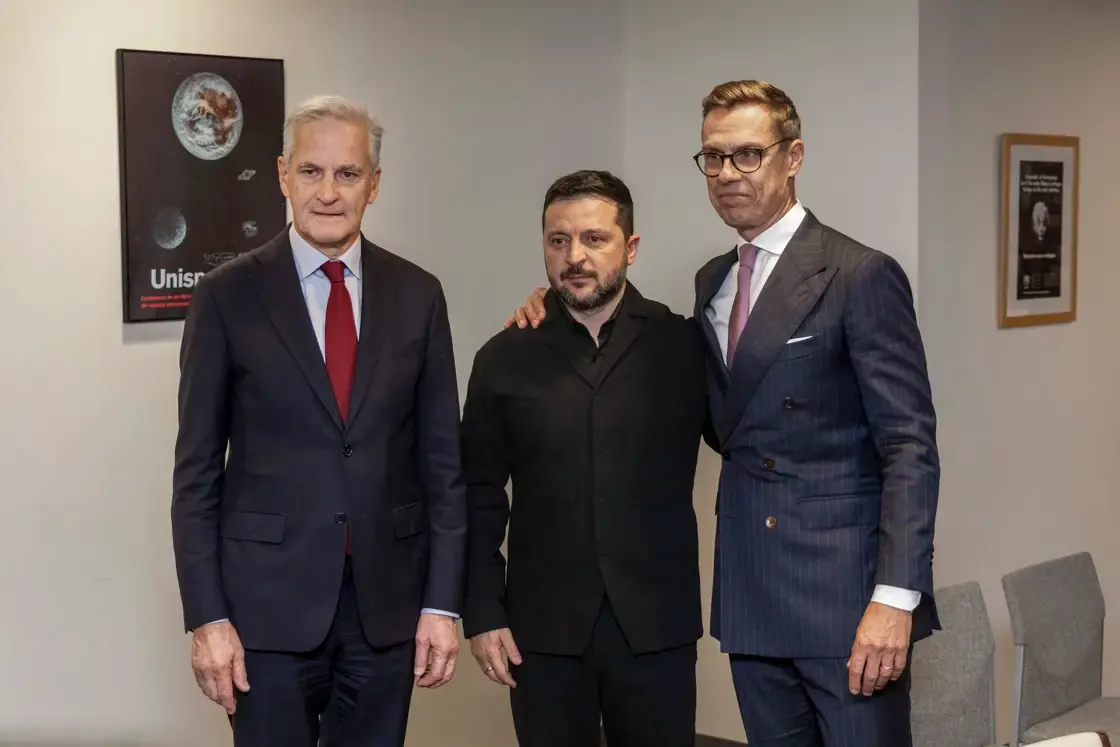
European Commission President Ursula von der Leyen, European Council President António Costa, Canadian Prime Minister Justin Trudeau, Spain's Prime Minister Pedro Sánchez, Finish President Alexander Stubb, Danish Prime Minister Mette Frederiksen, and Norwegian Prime Minister Jonas Gahr Støre were among those who visited Kyiv.
They all participated in the "Support Ukraine" plenary session led by Ukraine's President Volodymyr Zelensky. Dozens of other world leaders joined the session online, including the presidents of Poland, Germany, Turkey, Czech Republic, Switzerland, and Moldova, as well as prime ministers of the Netherlands, Japan, Belgium, Bulgaria, the UK, and Greece, among others, the Ukrainian presidency said in a press release.
During the meeting, Ukraine's allies unveiled new aid packages, as per the statement. European Commission President Ursula von der Leyen confirmed that Ukraine will receive €3.5 billion in assistance as early as March.
Swedish Prime Minister Ulf Kristersson announced that Sweden will allocate €100 million for air defense systems, while Spanish Prime Minister Pedro Sánchez pledged a €1 billion military aid package to be delivered this year.
Canadian Prime Minister Justin Trudeau said the country will provide Ukraine with the first part of a $5 billion aid package, funded by revenues from frozen Russian assets. Canada also plans to issue a grant to support Ukraine's energy security and military equipment, ammunition, and medical kits.
UK Prime Minister Keir Starmer said that his country will provide Ukraine with an earlier announced £4.5 billion defense aid package.
Norwegian Prime Minister Jonas Gahr Støre announced that Norway will allocate €1 billion in humanitarian and civilian aid for Ukraine, along with €300 million to support its energy sector. Additionally, Norway plans to establish an investment channel for the Ukrainian industry, committing another €300 million to this initiative. In total, Norway will provide €3.5 billion in aid to Ukraine this year, according to the press release.
UN Security Council adopts US resolution calling for swift end to Ukraine war; no reference to Russian aggression
The UN Security Council on Monday approved a US-drafted resolution on Ukraine, which Russia supported, containing no criticism of Moscow's aggression on the third anniversary of its invasion of Ukraine.
The resolution was passed with 10 votes in favor, none against, and five abstentions, including from France and Britain, which could have vetoed it. The text "implores a swift end to the conflict." Several amendments to the resolution brought by Russia and European countries did not pass.
"Our draft resolution is elegant in its simplicity. A symbolic, simple first step toward peace. The three brief paragraphs echo the spirit of the UN Charter, and must, as in 1945, affirm that this war is awful, that the UN can help end it, and that peace is possible," Acting US Ambassador to the UN Dorothy Shea said at the meeting.
The vote follows an intensive diplomatic fight at the UN General Assembly which just hours earlier adopted two resolutions on Ukraine, one from the US and one from Ukraine and its European allies.
The assembly first passed the Ukrainian resolution, which calls for the immediate withdrawal of Russian troops and condemns Moscow's aggression as a violation of the UN Charter. The vote was 93-18 with 65 abstentions.
The assembly then reviewed the US-drafted resolution, which recognizes "the tragic loss of life throughout the Russia-Ukraine conflict" and "implores a swift end to the conflict while urging a lasting peace between Ukraine and Russia," but avoids any mention of Moscow's aggression.
Two European Union-drafted amendments to the US resolution were adopted: one adding "Reaffirming its commitment to the sovereignty, independence, unity and territorial integrity of Ukraine within its internationally recognized borders, extending to its territorial waters," and another replacing "lasting peace between Ukraine and the Russian Federation” with "just, lasting and comprehensive peace between Ukraine and the Russian Federation, in line with the Charter of the United Nations and the principles of sovereign equality and territorial integrity of States."
An amendment proposed by Russia to include "addressing its root causes" after "a swift end to the conflict" was rejected.
This resolution passed 93-8 with 73 abstentions, with Ukraine voting in favor, the US abstaining, and Russia voting against it.
Ukraine may join EU before 2030, says European Commission president
Ukraine could become a member of the European Union before 2030 if it maintains the current pace and quality of reforms, European Commission President Ursula von der Leyen said on Monday at a press conference in Kyiv.
"I really appreciate the political will that is there. I would even say Ukraine's merit-based process, if they continue at that speed and at that quality, perhaps they could be earlier than 2030," Von der Leyen stated.
At the same press conference, Ukraine's President Volodymyr Zelensky said he hoped the war with Russia would end this year, stressing that Ukraine needs security guarantees to deter Russia.
EU Council President António Costa said accession to the EU would be the most important security guarantee for Ukraine's future.
Von der Leyen and Costa were in Kyiv on Monday, along with a number of other Western leaders, to mark three years since the Russian invasion of Ukraine.
During the day, they held a meeting with Zelensky during which they discussed Ukraine's EU accession process, among other issues, Zelensky's office said in a press release.
Zelensky expressed hope that Von Der Leyen and Costa will facilitate a prompt opening of the negotiations on "fundamentals," one of the six main areas or "clusters," up for negotiations on the country's path to joining the EU.
Ukraine applied for EU membership several days after it was invaded by Russia in February 2022, and was granted candidate status in June that year. Membership negotiations opened in June 2024.
European Commission announces fresh energy security package for Ukraine plus €37 million for nuclear safety
The European Commission (EC) has proposed a new support package for Ukraine to strengthen its energy system and facilitate full integration into the European energy market as well as accelerate domestic renewable power production.
The package, whose financial details have not been disclosed, includes Ukraine's electricity market integration with the EU by spring 2027, and further integration in the EU gas sector.
The commission will also help finance gas purchases for Ukraine, particularly through the Ukraine Facility in collaboration with its implementing partners, it said in a press release on Monday.
In addition, the package will accelerate investments in renewable energy, adding up to 1.5 GW of generation capacity—an increase of approximately 25% in Ukraine's total renewable energy capacity, the EC said. Funding will be provided through the Ukraine Facility.
Since the Russian invasion in February 2022, the EU has allocated over €2 billion to increase the resilience of Ukraine's energy system, as per the statement.
Separately, the Commission also said on Monday it will allocate nearly €37 million to Ukraine from the EU Instrument for Nuclear Safety Cooperation (INSC). The funding will be largely channeled through the European Bank for Reconstruction and Development (EBRD) to support the repair of the Chornobyl Shelter which was damaged by a Russian drone attack.
On Monday, EC President Ursula von der Leyen was among Western officials who visited Kyiv to mark three years since the start of the Russian invasion of Ukraine. At a meeting of the leaders chaired by Ukraine's President Volodymyr Zelensky, Von der Leyen stated that Ukraine will receive a new €3.5 billion payment from the EU in March.
Norway to provide NOK 12 billion in civilian support to Ukraine in 2025
The Norwegian government said on Monday it will provide more than NOK 12 billion ($1 billion) to Ukraine this year, focusing on energy security and humanitarian aid.
Of the total, Norway plans to disburse NOK 4.5 billion for energy security and supply, including nuclear safety and security and the purchase of gas, NOK 3 billion for humanitarian assistance, and NOK 3.3 billion for budget support and reconstruction efforts.
A further NOK 750 million will be allocated to business development and the private sector in Ukraine, and NOK 540 million for civil society, the government said in a press release.
Norway has committed to providing Ukraine with a minimum of NOK 155 billion under the Nansen Support Programme for Ukraine between 2023 and 2030.
Of the NOK 35 billion currently allocated for 2025 under the program, NOK 22.5 billion will be provided as military support, as per the statement.
Separately, Norway's government said on Monday it also plans to provide NOK 3.5 billion for the procurement of military equipment for Ukraine from the Ukrainian defense industry and NOK 600 million for the procurement of drones for the Ukrainian armed forces.
Denmark commits DKK 405 million for Ukraine's reconstruction, humanitarian aid
Denmark has committed to providing DKK 405 million ($57 million) to Ukraine for reconstruction efforts and humanitarian assistance, the Danish Foreign Ministry said.
Of the total announced funding, DKK 200 million will go towards the reconstruction efforts, including the restoration of destroyed energy infrastructure, the rebuilding and repair of schools, and public transport.
The remainder will be provided to Ukraine as humanitarian support for emergency aid, demining, and relocation of refugees, the ministry said in a press release on Sunday.
"Three years of war have left Ukraine with a tremendous need for reconstruction, with substantial damages to infrastructure and production capacity," the ministry stated.
In addition, the humanitarian situation in Ukraine remains critical, with large portions of the civilian population facing destroyed homes and limited access to healthcare, education, water, heating, and electricity.
Separately, Danish Prime Minister Mette Frederiksen announced on Monday a DKK 2 billion in aid to Ukraine, focusing on ammunition supplies and the formation of a Ukrainian brigade in cooperation with Nordic and Baltic countries, during her visit to Kyiv to mark three years since the Russian invasion of Ukraine in February 2022.
Since February 2022, Danish support for Ukraine amounts to about €7.44 billion in military aid and about €783 million in civilian contributions.
Finland to support Ukraine's recovery with additional €4.5 million
Finland will allocate €4.5 million to the Partnership Fund for a Resilient Ukraine (PFRU) between 2025 and 2027 to support the country's recovery, focusing on regions in southern and eastern Ukraine that are most damaged by the war.
The PFRU enhances regional and community resilience by supporting early recovery efforts and addressing urgent needs for basic public services and emergency aid. It also focuses on initiatives to foster long-term peace and strengthen national identity and unity.
"The reconstruction of Ukraine and support for basic public services will enhance the country's resilience, which is also needed to achieve lasting peace," Finish Foreign Trade and Development Minister Ville Tavio said in a press release on Monday.
In the first phase of the PERU between 2022 and 2024, Finland contributed €4.3 million to the fund. During this period, PERU implemented 577 projects supporting Ukraine's recovery, as per the statement.
Apart from Finland, Canada, Estonia, Netherlands, Norway, Sweden, Switzerland, the UK, and the US are also contributing to PERU.
Finland also recently announced it will provide €198 million in military aid to Ukraine, bringing the total of military assistance to the war-hit country to €2.5 billion.
Dragon Capital sells Kyiv warehouse complex to owner of EVA retail chain
Dragon Capital, one of Ukraine's most prominent investment firms, has sold the Omega-1 Logistics warehouse complex in the Kyiv area to EVA retail chain owner RUSH, the investment firm said.
The firms didn't disclose the transaction price of the 19,119 sqm warehouse in the city of Brovary, part of the metropolitan Kyiv area. Dragon had acquired the warehouse complex in 2017, according to a press release.
The transaction marked the second Kyiv-area warehouse Dragon has sold in less than a year. In August of last year, the firm sold a large warehouse complex to Avrora, the country's biggest retailer, in what it described as a "landmark deal" for the war-time era.
That complex, ranked the sixth biggest before the full-scale Russian invasion, included a 14.4-hectare plot of land, 7,000 square meters of office and warehouse premises, and a 90,000 square-meter building that was destroyed in fighting in 2-2022.
Dragon Capital says its real estate portfolio now includes 25 properties with a total area of 560,000 sqm.
"We strongly believe in the high investment potential of Ukrainian real estate and see it as the best way to bet on Ukraine’s macroeconomic growth while generating current income equal to or even exceeding the yields on Ukrainian government bonds," the company said in the press release.
Hotel Ukraine owner Maksym Krippa invests in Kyiv real estate developer DIM
Ukrainian businessman Maksym Krippa has made an investment in DIM, a major real estate developer active in the Kyiv region, DIM said on Monday.
Krippa and DIM have "finalized an agreement on partnership and cooperation. Krippa's involvement will ensure the completion of the developer's current projects and the commencement of work on new large-scale projects," DIM said.
In a press release announcing the partnership, DIM did not disclose the size of the investment or other terms of the agreement.
Last year, Krippa acquired the iconic Hotel Ukraine in central Kyiv for UAH 2.5 billion ($60.2 million) in a public auction. In 2023, Krippa acquired Kyiv's largest business center Parus.
"I decided to invest in DIM's projects not only because of their significant investment potential, but also due to our shared approach to doing business during the war: they are not afraid to build, and I am not afraid to invest," Krippa stated.
DIM Managing Director Oleksandr Nasikovskyi said Krippa's investment will allow the company to stay independent of sales volumes, sustain construction momentum, and guarantee that our investors see projects completed on schedule.
DIM's portfolio includes real estate in Kyiv and the surrounding region with a total area of over 900,000 square meters (sqm). The developer has put a total of 3,670 apartments into operation, and completed the construction of over 355,922 sqm of residential and commercial space, as per the statement. Six projects totaling over 346,000 sqm are currently under construction.
Positive outlook taking hold among European executives in Ukraine, survey shows
The percentage of executives at European businesses operating in Ukraine who say their business has a positive outlook has jumped to 40% from 27% over the past six months, according to a survey by the Kyiv-based European Business Association (EBA).
Still, 46% of the executives surveyed by the association rate their outlook as "satisfactory" and 14% rated it as "negative," according to the association, which represents European businesses in Ukraine.
The EBA, which has more than 800 member businesses, surveyed 102 senior executives between Feb 5 and Feb 16 for the Business During War study.
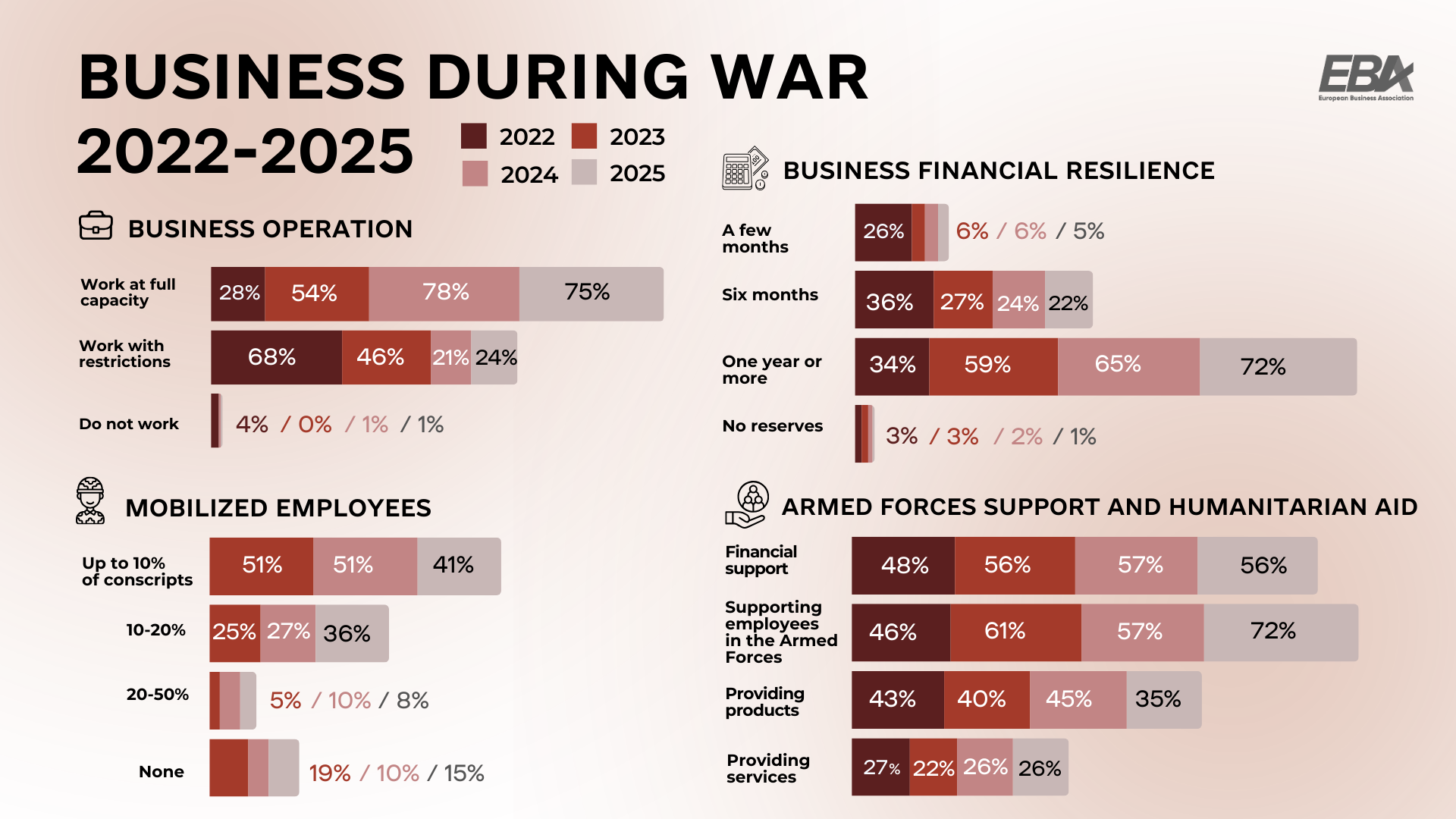
The number of respondents who expected business conditions to deteriorate in the year ahead dropped to 29% in the latest survey from 56% in the same survey six months earlier. Meanwhile, the number who expect improvement doubled to 32% from 16%.
The results also suggest that 77% of companies plan to continue operating in Ukraine even if the war doesn't end this year, while 19% were uncertain and 4% said they may "reconsider their presence in the Ukrainian market."
At the start of this year, 75% of the companies surveyed were operating at full capacity, while 24% were operating with some restrictions and 1% had ceased entirely. That's an improvement from six months early when 64% were at full capacity and 36% faced restrictions.
Some 75% in the latest survey said a shortage of qualified workers and the military draft were an operational constraint, while 55% cited geographical limitations due to war, and 41% cited air raid alerts.

Kurt Volker: The 4 pillars of Trump's Ukraine policy
The key pillars of US President Donald Trump's approach to the war in Ukraine are "ceasefire, reciprocity, deterrence, and burden-sharing," wrote Kurt Volker, a former US ambassador to NATO, in an op-ed for the Center for European Policy Analysis.
Trump's #1 goal is a ceasefire, followed by deriving a benefit for the US from its aid to Ukraine, preventing a future outbreak of war, and pushing Europe to spend more on defense. If those four pillars are achieved, "it would satisfy Trump’s policy objectives, while guaranteeing Ukrainian sovereignty, independence, and future security."
The BMJ: Ukraine offers a model of health system resilience
Despite suffering the highest number of attacks on medical facilities ever recorded by the World Health Organization in a conflict, "Ukraine’s health system remains operational and well governed," according to an op-ed in The BMJ, formerly known as the British Medical Journal.
"While the system depends on aid, that aid is spent efficiently and with good outcomes. Most facilities continue to provide services and 90% of Ukrainians report being able to access necessary healthcare. Ukraine’s successes can provide lessons to other countries on health system resilience in the face of crisis."

Ukraine's post-war recovery hinges on growing labor force and private investment, CFR writes
Long-term stability in Ukraine depends on the recovery of the country's economy, which in turn depends largely on growing the labor force and attracting private investment, according to an analysis published by the Council on Foreign Relations.
Current Western thinking about the post-war recovery is "blind to both," the authors argue.
Ukraine's population has been shrinking since the fall of the Iron Curtain, and that trend was severely aggravated by the outbreak of full-scale war, which sent some 6 million refugees fleeing abroad.
Surveys indicate that only about half of Ukrainian refugees in Poland and just a third of prewar migrants intend to return, in part due to the much higher wages in their host countries.

This trend must be reversed or efforts to rebuild infrastructure and modernize industries will falter, the authors write.
They call for a multinational repatriation strategy, including social security measures—such as pension portability, retraining programs, transitional welfare support, and even incentives tied to work-year credits—to encourage displaced workers to return and rejoin the labor market.

Equally important is the need to attract private investment, the analysis states.
Ukraine’s long-term economic growth hinges on mitigating investor risk through structural reforms and insurance mechanisms as well as modernizing key sectors like manufacturing and IT.
By establishing a secure investment climate—including transparent governance, a stable currency framework, and clear policy commitments—Ukraine can draw the private capital needed for sustainable recovery, the authors write.
Combining these efforts to boost the labor force with targeted incentives for private investment is essential for Ukraine to outpace regional competitors and secure its economic and strategic future.

Social Media
Ukraine's Priorities for EU Accession
Ukrainian Economy Minister and First Deputy Prime Minister Yulia Svyrydenko recapped a meeting held yesterday between the Ukrainian government and the European Commission that covered the process of integrating Ukraine into the European Union.
Four priorities of the government in that direction are completing trade liberalization consultations, simplifying access to the European market for Ukrainian industrial products, and including Ukraine in the Single Euro Payments Area (SEPA) to allow for quick payments between Ukraine and SEPA-member countries, Svyrydenko said.
Updated National Private Investment Guide
UkraineInvest, the state investment promotion agency, announced that it has updated its Rebuilding Ukraine with the Private Sector guidebook, with new macroeconomic indicators and further details on the business environment.
The guidebook, available here, also now contains new details on trade and logistics, including updated transport trends, as well as new information on ongoing initiatives and a recap of Ukraine's 2024 achievements, such as digital transformation and public governance reform.
Feed-in-Tariff Mechanism Explained
Maksym Maksyenko, head of real estate and infrastructure at the Ukrainian law firm Avellum, promoted a short article explaining the workings of the Feed-in-Premium mechanism for renewable energy solutions, which replaced the Feed-in-Tariff mechanism in 2024.
The five-slide presentation on LinkedIn says the new mechanism lets producers "freely trade electricity on the market, receiving compensation from the Guaranteed Buyer for the difference between the fixed pre-agreed price and the actual market price.

URN Daily: Sense Bank and Ukrgasbank for sale? And US seeks to cancel $4.7 billion of Ukraine's debt