

Today's Contents
Reporter's Notepad:
- 5 security tips for investors in Ukraine's rebuild, from the ex intelligence officer who led Grammarly's war-time security
Just The Facts:
- EU seeks to grant Ukraine access to Single Market in final peace deal, The Telegraph reports
- Trump wants Zelensky to make concessions in peace talks to restart aid, intelligence sharing, sources say
- BII and Proparco to provide risk-sharing guarantees worth $57 million to EBRD to support Ukraine's cross-border trade
- Czechia gets €188 million in EU funding to back companies involved in Ukraine's reconstruction
- Poland's Orlen outlines partnership with Naftogaz to diversify Ukraine's LNG supply
- EBRD mulls lending Ukrainian grocery store chain Vrus $25 million to expand retail operations
Here's What They Think:
- The Conversation: Trump's minerals deal won't support Ukraine's security
- SCMP: Trump is bringing back great power geopolitics with Ukraine peace dealings
Sober Second Thought:
- Zelensky's approval rating rose 10 percentage points after clash with Trump, survey finds

Dear subscribers,
Here's the third installment in our series of advice columns from seasoned Ukraine hands on investing in the reconstruction of Ukraine.
Last week, we brought you 5 tips on banking in Ukraine, with Citi Ukraine chief Alexander McWhorter.
The week before we offered 5 tips on project management in Ukraine, with Gleeds country director Colin Ross.
This week, we bring you:
5 security tips for investors in the rebuild, from the ex intelligence officer who led Healix's war-time Ukraine operation
When foreign investors consider joining the reconstruction, they often fearfully imagine Russian missiles hitting their offices, land mines crippling employees or drone strikes destroying warehouses.
Not to fear, says George Janjalia, the former Georgian military intelligence officer who led security in Ukraine for global risk management, security and health services firm Healix through three years of war. When the war ends - whether in a tense truce or permanent peace - the concern will no longer be missiles.
Consider the new security challenge:
Eager executives, many with little to no experience in Ukraine, will be chasing billions of dollars in contracts in a country fresh off of years of brutal warfare, replete with weapons, with hundreds of thousands of veterans suffering from PTSD, amid a resurgence of fractious internal politics.
George reflects that Ukraine for years will remain one of the best countries in the world for a man of his experience and profession - risk assessment, counter-surveillance, crisis response, and more, with an MBA and a Master’s in Information Management.
On behalf of Healix, which serves many of the world's most famous companies and organizations, George was embedded for three years with a globally famous AI firm with Ukrainian roots. Healix specializes in medical and security evacuation, crisis response, travel risk management, and global assistance services worldwide.
Now that the client is taking security in-house, George must decide whether to return to his homeland or pursue another contract in Ukraine. In that context, he offers the following tips to foreign investors considering joining the $500 billion reconstruction of Ukraine:
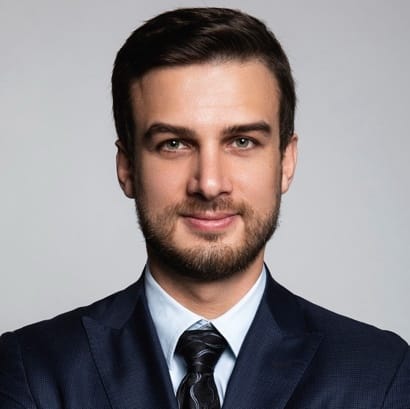
George Janjalia's 5 Tips for Investors in the Reconstruction
#1 - The threats will change dramatically after the war, but they will remain serious.
"Right now, a lot of companies are interested in coming to Ukraine. They have to have either in-house or outsourced security. If something happens, they have to have a system in place to say that this is what we had again, it happened, but we will fix it, or we have a means to respond to that, or so on so forth. But they also have to realize the risk context will change. Right now, the biggest risks are the explosions and fires caused by projectiles. When we move to peace time, the situation will change. One of the biggest things that will come into play will be the criminal world that can be created with disgruntled soldiers with PTSD. We're talking about a lot of people who will be really, really angry."
Many people who are serving think that they will finish service, and then work for private military companies, but the private military companies don't really want them. They're afraid of the way they'll behave.
Another thing is the extremist organizations, which have both political and military sides. What will they do? So there's another risk, like inter conflict inside the country, between the political factions, which we don't know how bad will be.
#2 - Remember that you are now protecting your employees' lives.
"When businesses are talking about risk, they don't usually mean risk to life and limb. Well, here it's risk to life and limb. As the leader of an organization, you have to protect your employees' lives. So, on security, you have to be pro-active and not reactive. "
"Make sure you have an understanding of what threat actors there are, and what risks there are from these threat actors, and what are the ways to mitigate it? For some companies, if they had a full picture, they might not come to Ukraine at all."
"Also, you need to be in Ukraine to understand it - you can't do business from outside. Dynamics change so fast that you won't be able to understand what's going on unless you're here. And security will be very important in the next five to 10 years."
#3 - Understand that the mindset is different. Corruption, for example ...
"To understand how things will develop, you need to understand the mindset in the country. For example, corruption is not just a problem within the government. It's a cultural problem, because for years under communism, Ukrainians believed that cheating was OK, because they were cheating the Soviet Union, which they didn't see as their country. Sometimes people were trying to do good for themselves and their families - they were doing some small business. Today, that is considered admirable, but back then it was a different system, so it was considered a bad thing. So the good and the bad were mixed up - right things were wrong things. It's easy to lose your moral compass in that circumstance."
#4 - Be ready for the grid to go down, a lot.
"As the war finishes, we will still have energy problems because the energy infrastructure has been badly damaged. Every time they start repairs, they will have to shut things down. The Ukrainian energy infrastructure has one of the highest levels of redundancy in the world - it's very resilient - because the amounts of strikes is tremendous. But they will still have to rebuild that redundancy. Nobody think that Russians will not be a threat anymore when the war ends. As they rebuild that there will be shutdowns, and businesses must be prepared.
"To ensure business continuity, you need alternate sources of energy, alternate internet connections and maybe even alternate sources of heating. A company I represented bought their employees two EcoFlow batteries. It's a 1 kWh battery that can allow you to continue working."
#5 - The post-war period will bring a return to internal political division and rival factions.
"Foreign investors must account for legal uncertainties, shifting regulations, and evolving security guarantees when you're planning long-term engagements in Ukraine.
"When the war ends, the country will face political uncertainty, economic reconstruction challenges, and maybe internal divisions again. The transition from wartime governance to peacetime administration will test the stability of institutions, and it could lead to protests, policy disputes, and regional tensions—especially in areas they were once occupied by the Russians."
Bonus Tip - Foreigners will be safer than locals, but you will attract more scammers.
"Ukrainians in general are very thankful for what the West is doing for them. So I would say you are physically safer from attack than you might think. But definitely foreigners are perceived to have more money. So they will be a target for scamming and frauds - non-violent criminals. I think that it is less likely that foreigners will face violence in the post-war period - the government will try to prioritize and organize its resources around making sure that it doesn't happen."
For questions related to daily news, story suggestions, scoops and other newsy matters, please message URN newsroom chief Valentina Bajic at valentina@ukrainerebuildnews.com.
For sponsorships, the URN Guidebooks, the Tips for Investors column and other general matters, email founder Adam Brown at adam.brown@ukrainerebuildnews.com.
If in doubt, email us both and we'll sort it out.
Now, on with the headlines of the day ...

EU seeks to grant Ukraine access to Single Market in final peace deal, The Telegraph reports
European Commission President Ursula von der Leyen is prepared to stretch EU rules to the "breaking point" to guarantee Ukraine's access to the Single Market, The Telegraph reported, citing a senior EU official.
While the EU would decide which sectors to open and which to restrict, a key focus would be Ukraine's defense industry, which already supplies 55% of its army's weapons, including advanced drones, according to The Telegraph.
The plans could form a part of the EU's final peace deal, but they are not contingent on it, as providing Ukraine with Single Market access in exchange for arms would help fast-track its EU membership, The Telegraph reported.
Tariff-free access to Ukrainian arms would also strengthen EU defense capabilities, aligning with the recently announced $800 billion European defense investment plan.
The EU Commissioner for Enlargement, Marta Kos, said in a speech last week that the integration of Ukraine's defense industry "could be a fire starter for a much more integrated European defence market."
She added: "We are also working on plans to accelerate the integration of Ukraine into many more parts of the Single Market... This will be a stepping stone to speed up the reconstruction of Ukraine."
The EU has already linked Ukraine’s electricity market to its own, enabled tariff-free agricultural exports, and is discussing further integration in services sector, The Telegraph said.
Von der Leyen said last month that Ukraine could become a member of the European Union before 2030 if it maintains the current pace and quality of reforms.
Trump wants Zelensky to make concessions in peace talks to restart aid, intelligence sharing, sources say
US President Donald Trump has made it clear to his aides that he wants President Volodymyr Zelensky of Ukraine to show willingness to make concessions in peace negotiations, such as giving up territory to Russia, unnamed US officials told NBC.
Signing of the proposed minerals deal alone won't be enough for the US to restart military aid and intelligence sharing with Ukraine, they said.
Trump allegedly also wants Zelensky to take steps toward holding elections in Ukraine and perhaps consider stepping down as the country's leader.
Zelensky's term was supposed to end in 2024, but presidential and parliamentary elections cannot be held under martial law, which has been in force in Ukraine since February 2022.
After the US last week halted military aid to Ukraine and intelligence sharing with the war-torn country, Russia intensified attacks on Ukraine, NBC reported.
The US has no indication that the pause in intelligence sharing directly influenced the Russian attacks, the sources told NBC, nothing that these large-scale attacks were likely planned before the halt in intelligence and aid.
Congressional Republicans are urging the White House to resume aid and intelligence sharing, and the two officials who spoke to NBC expressed optimism that the flow of weapons, equipment, and intelligence could restart as early as this week.
US and Ukrainian officials are set to meet in Saudi Arabia later this week to work on a potential peace agreement to end the war with Russia.
BII and Proparco to provide risk-sharing guarantees worth $57 million to EBRD to support Ukraine's cross-border trade
The UK's development finance institution British International Investment (BII), and the French development agency Proparco will provide risk-sharing guarantees worth a total of $57 million to the European Bank for Reconstruction and Development (EBRD) to support the lender's trade finance exposure in Ukraine.
BII will allocate up to $37 million, while Proparco will provide $20 million in risk-sharing guarantees for the EBRD's Trade Facilitation Programme (TFP) to support Ukraine's cross-border trade, the EBRD said on Monday.
This initiative expands on a plan drafted last year by development finance institutions to coordinate co-investments in Ukraine's private sector and will strengthen the EBRD's ability to support import and export activities, helping Ukraine maintain trade with international partners and deliver essential goods and services to its citizens, the EBRD said in a press release.
Since Russia's full-scale invasion of Ukraine in 2022, trade flows and supply chains have faced severe disruption. Beyond physical damage to land and transport routes, Ukrainian importers and exporters have struggled to access financing, as international banks remain reluctant to take on direct risk in Ukrainian trade transactions, as per the statement.
To address this, the EBRD's TFP has played a vital role in stabilizing global and regional food and energy supply chains, facilitating over €1.4 billion in trade transactions for essential goods since the war began.
Trade remains one of the EBRD's five investment priorities in Ukraine, alongside energy and food security, and support for critical infrastructure and the private sector, the lender noted.
Czechia gets €188 million in EU funding to back companies involved in Ukraine's reconstruction
The Czech Republic will receive €188 million from the European Union's Ukraine Facility to support Czech companies involved in the reconstruction of Ukraine.
"This is great news for Czech entrepreneurs. They already have dozens of projects underway in Ukraine, thanks to our government's support, and now even more will be able to get involved," said Czech Prime Minister Petr Fiala.
The funding from the European Union's Ukraine Facility will come in the form of guarantees for investment loans and combined guarantees with grants and will support two programs proposed by Czechia, the country's Foreign Affairs Ministry said in a press release on Friday.
The first program, for which the EU will allocate €100 million in guarantees for bank loans, targets the reconstruction of Ukraine's energy sector. The Czech Ministry of Industry and Trade and the Ministry of Foreign Affairs plans to top that with a further CZK 850 million ($37 million) in loan financing for local companies, as per the statement.
"The subject of guaranteed loans will be to support productive investments directly in Ukraine, especially in the energy sector, but also in other strategic sectors," said Vilém Řehák, who coordinates the preparation of the program at the National Development Bank (NRB).
"They may be subsidiaries of Czech companies, local companies (co-)owned by Czech owners, Czech-Ukrainian joint ventures, Czech-Ukrainian project SPVs or Ukrainian companies with a Czech partner," he added.
For the second Czech program, which focuses on modernizing six selected Ukrainian hospitals, the EU will provide €88 million in the form of bank loan guarantees, grants and technical assistance.
This support will enable hospitals to acquire modern medical equipment from Czech manufacturers and provide professional training for Czech experts. The program will be implemented by the Czech Development Agency in collaboration with the National Development Bank, with the Czech Republic contributing approximately CZK 200 million from its national budget.
The Ukraine Facility, the EU's financial assistance program for the country for the period 2024-2027, is worth a total of €50 billion.
Poland's Orlen outlines partnership with Naftogaz to diversify Ukraine's LNG supply
Polish energy firm Orlen said it has signed a memorandum of cooperation with Ukraine's oil and gas company Naftogaz on March 7, outlining terms of their partnership in the liquefied natural gas (LNG) sector.
As part of the memorandum, the companies also signed a contract to supply about 100 million cubic metres of gas to Ukraine. The gas will come from an LNG cargo delivered to Klaipėda, Lithuania, then will be transported via the GIPL pipeline through Poland to the Drozdowicze interconnector, where Naftogaz will receive it.
"Our relationship will be based on commercial terms, but securing an additional source of gas is vital for Ukraine also from the point of view of its security," said Robert Soszyński, Orlen's Vice president in a company press release.
The Ukrainian government plans to import up to 800 million cubic meters of gas from Europe in February and March to offset a production drop of up to 40% caused by Russian missile strikes on gas facilities, Reuters reported last month, citing an unnamed senior industry source.
EBRD mulls lending Ukrainian grocery store chain Vrus $25 million to expand retail operations
The European Bank for Reconstruction and Development (EBRD) said it is considering providing a $25 million multicurrency senior long-term loan to Ukrainian grocery store chain Varus Group to expand its retail operations in the country.
The financing would help Varus boost employment opportunities for people with disabilities and other war-affected groups, while also mitigating risks of maintenance of local food supply in the country, the EBRD said.
The EBRD said on Friday in a project document the total cost of the project, which has passed concept review and is awaiting final review, amounts to $53 million.
Varus currently operates 113 stores in the Dnipro and Kyiv regions, with limited presence in Zaporizhzhia and Odesa regions.

The Conversation: Trump's minerals deal won't support Ukraine's security
US President Donald Trump's proposed minerals deal with Ukraine can't by itself help Ukraine's security situation as markets don't care only about contracts but also react to explicit statements of support, Patrick E. Shea, senior lecturer at the University of Glasgow, wrote in an op-ed for The Conversation.
If the US wants to boost Ukraine's security through economic means, it would have to reinstate programs that support US investments abroad, such as USAID programs. In addition, President Trump would also have to work to reassure American allies, according to Shea.
SCMP: Trump is bringing back great power geopolitics with Ukraine peace dealings
US President Donald Trump has started returning to great power geopolitics which largely disappeared after the Cold War, especially in his efforts to end the war in Ukraine, leaving Europe more as a chess figure than a chess player, Li Xing, professor at Guangdong University of Foreign Studies, wrote in an op-ed for the South China Morning Post.
Trump's approach to international relations marks a clear shift from the post-Cold War unipolar era to a multipolar world, marked by the decline of US dominance, the EU's strategic challenges, China's rise, and Russia's growing assertiveness, according to Xing.

Zelensky's approval rating rose 10 percentage points after clash with Trump, survey finds
Ukrainian President Volodymyr Zelensky's approval rating jumped by 10% following a heated exchange in the Oval Office with US President Donald Trump and Vice President JD Vance on February 28, according to a survey conducted by the Kyiv International Institute of Sociology (KIIS).
As of the first half of February, 57% of Ukrainians trusted Zelensky, while 37% did not. However, in the period from February 14 to March 4, the level of trust in Zelensky rose to 67%, while the share of those who did not trust him declined to 29%, the survey showed.

Already in the period between February 14-28, trust in Zelensky became higher than in February 4-9, when the previous KIIS survey was conducted - before the launch of negotiations between the US and Russia.
In the period between March 1-4 only, trust in Zelensky increased to 68%, while distrust in the same period stood at 27%.

Geographically, trust in Zelensky is slightly lower in the East of Ukraine, but even in this region, the majority trusts him – 60% trust and 36% do not trust him. In other regions (West, Center, South) 66-69% trust and 28-30% do not trust him, according to the survey.

"At least for now, we are witnessing a process of unification of society against the backdrop of new challenges facing Ukraine. The growth of trust in the President over the recent period indicates that we are now seeing a 'rally around the flag'," KIIS Executive Director A. Hrushetskyi said in comments accompanying the results of the poll.
Hrushetskyi emphasized that the primary driver of unity and growing trust in Zelensky is not personal attacks against him, but that Ukrainians see the new US administration's rhetoric as an attack on the entire nation and its people.
"Ukrainians really want peace, but our results consistently show that the absolute majority is against peace under any conditions. Ukrainians are flexible and ready for even painful compromises, but not a compromise that would be capitulation. Ukrainians retain the will to fight and will continue it despite everything," Hrushetskyi noted.

Social Media Posts
Builders Talk to Prison System Amid Labor Crunch
The Confederation of Builder of Ukraine posted on social media that it organized an online event with Yana Makortova, a psychologist at the State Penitentiary Service of Ukraine, to discuss using the prison system to help overcome the labor shortage in construction.
"In 2023-2024, Ukraine's construction industry faced a shortage of over 150,000 workers. This shortage of skilled construction workers is slowing down infrastructure recovery and increasing construction costs. At the same time, more than 8,000 people are released from the penitentiary system annually, with up to 30% of them having construction skills."
French Private Equity
The Ministry of Economy of Ukraine posted that Economy Minister Yulia Svyrydenko, in her trip to France, met with representatives of 10 French private equity funds and explained how they can use the €200 million in funding from France via the Ukraine Fund to develop private equity funds in Ukraine.
"French private equity funds expressed interest in investing in small and medium-sized businesses and companies in sectors such as innovation, infrastructure, defense, space, mil-tech, agriculture, energy, critical materials. In particular, the French Direct Investment Fund for the Development of Critical Raw Materials InfraVia stated that it is ready to invest in Ukraine."
Careers
Nefco Seeks Ukraine Program Manager
Nefco, the international finance institution known as the "Nordic Green Bank," is looking for a program manager for its Ukraine Green Recovery program, which provides "financial and technical assistance to municipalities to conduct repairs and rebuild in an environmentally sound way."
"The new Programme Manager will - among other things - manage projects, oversee and progressively provide guidance and support to project managers, focusing on addressing obstacles and managing risks."
Tyson Barker
Tyson Barker, former US deputy envoy to the reconstruction of Ukraine under envoy Penny Pritzker and envoy Richard Verma, has become a non-resident senior fellow at the Atlantic Council Europe Center with a focus on US-EU relations, tech policy, geoeconomics, and Ukraine.
"Lots to say. Lots of reflection. This is not a moment to try to “preserve.” It’s a moment to “reinvent” in a way that draws on what makes 🇪🇺🇺🇦 and, most challengingly, 🇺🇸 great."
Ian Morgan
Long-time friend of Ukraine Ian Morgan, managing director of Amapola Capital, is looking for a new role, in London or possibly elsewhere, in corporate finance, project finance (particularly in the real estate sector), and real estate finance/advisory.
Ian speaks Spanish, Ukrainian, Russian, French, and Portuguese and has worked at Alvarez & Marsal, Amapola Capital and Westcore Europe.

URN Daily: Sense Bank and Ukrgasbank for sale? And US seeks to cancel $4.7 billion of Ukraine's debt