Today's Contents
Reporter's Notepad:
- 3 tips for investors seeking development finance to help rebuild Ukraine, from a 25-year DFC veteran
Just The Facts:
- Russia says it's still 'working' with US on Ukraine peace deal, bilateral relations
- EBRD, Aon's war risk insurance facility delivers over €5 million in reinsurance coverage for Ukrainian firms in first weeks
- Ukraine's infrastructure recovery drives construction, but growth slows, GMK Center says
- Ukraine's GDP warrant edges close to its biggest daily loss since war outbreak
- Netherlands to provide €2 billion to Ukraine in 2025, including €500 for drone project
- Sweden announces record SEK 16 billion military aid package to Ukraine
Here's What They Think:
- EPRS: EU, Ukraine have potential to boost energy cooperation
- UNFPA representative to Ukraine: Ukraine needs to invest in lifelines, not just infrastructure
Sober Second Thought:
- Only 1 in 6 Ukrainian companies understands what sustainable business means, but vast majority supports ESG adoption, study finds
The Rebuilders' Social
- The Ministry of Digital Transformation posts about Ukrainian e-signatures in the EU, UkraineInvest promotes a guide to energy investing, the Economy Ministry outlines French reconstruction aid, Spanish companies discuss joint reconstruction work with Ukrainian counterparts, and more.

Dear Subscribers,
Here's the latest installment in our Tips for Investors. (To see the full series so far, visit https://www.ukrainerebuildnews.com/tag/tips-for-investors/.)
3 tips for investors seeking development finance to help rebuild Ukraine, from a 25-year DFC veteran
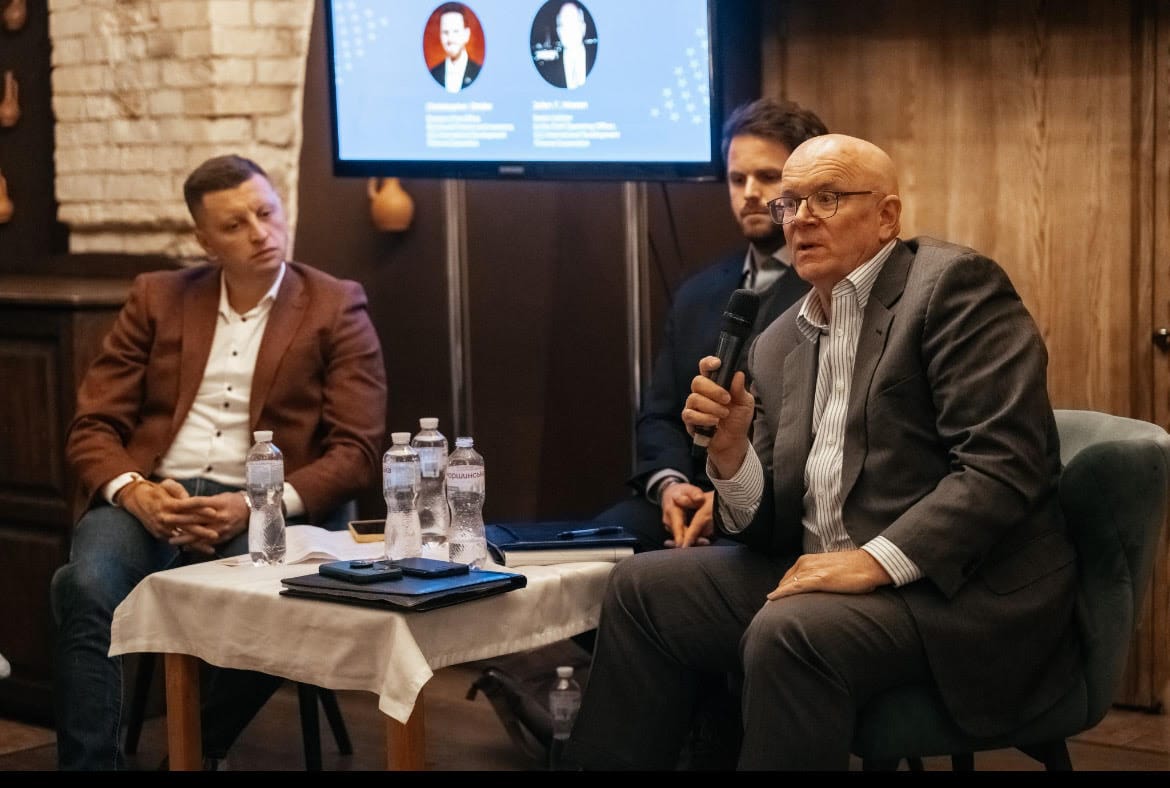
John Moran, who's resigning from the US International Development Finance Corporation (DFC) after nearly 25 years, has garnered a wealth of expertise in many topics crucial to Ukraine's future, particularly in de-risking and catalyzing private sector investment in tough environments.
From April of 2023 until January of this year, he served as senior adviser on Ukraine Recovery Initiatives, cooperating closely with Penny Pritzker, the US envoy to the reconstruction of Ukraine, and coordinating DFC projects for Ukraine with the private sector.
In January, he took a deferred resignation offer, which means he stays on rthe DFC payroll until September, but is effectively off the job. In the meantime, he's exploring the possibilities of a new life in the private sector in a consulting or senior advisory role, preferably focused on the reconstruction of Ukraine.
In a conversation with Ukraine Rebuild Newswire, John recounted a career in international economic development, spanning multiple sectors and regions. From his early work in private practice focusing on African markets to his more recent roles, he has consistently focused on mobilizing private capital in emerging economies.
Following are three tips for investors derived from the conversation:
John's 3 Tips for Foreign Investors in Ukraine
#1 - When Approaching a DFI, Come With a Well-Defined Deal
"Have a deal ready that's pretty well baked so you can actually answer the question going in of what role the DFI can play. Don't just say 'I have this big idea and I'm looking for this big slug of capital so can you introduce me to people?' We're not really matchmakers."
"In my position you see a lot of people and a lot of deals, and the deals that get the most traction are those that have a clear idea behind them of what the role for would be for the DFI and that includes where the DFI fits in the capital stack. If you're looking for equity, that's OK. If you're looking for debt and/or political risk insurance, that could be OK too. But you have to have it all pretty well defined."
"You can't just say, for example, 'I want to do a $100 million building for food storage, and need investment capital and political risk insurance.' That makes it too hard for the investment officers and deal teams to pitch, and DFIs are driven, ultimately, by deal teams."
#2 - Research the Political Landscape, and Your Partners, Thoroughly
In a land traditionally dominated by oligarchs, who are typically avoided by DFIs, and shifting political allegiances, as well as corruption, it's important to know the people you're planning to deal with before you approach a DFI, he said.
"You're going to need fairly extensive knowledge about who your partners are, especially if you're dealing with somebody who has a history in Ukraine or when you're dealing with politically high-profile people."
"The international community will shy away from the oligarchs and they'll have an insistence on transparency and I don't think that will change."
"And it's the same when you're approaching a DFI. Know what they can do for you and know what your ask is. Sometimes you're asking for something specific but what you really want is that halo effect. You want to come in with, for example, the EBRD or perhaps bilateral DFIs on your side so some local authority doesn't screw you around."
#3 - Seek Local Professionals Who Can Guide You
Investors will have a tougher time persuading a DFI to support a project if they have no experience in Ukraine, John said, adding that a trip to Ukraine may very well change an investor's perspective on a given deal.
"Say you're somebody from Minnesota looking for political risk insurance on an ag deal. They know ag deals or grain deals backwards and forwards, but they've never done something in Ukraine. Maybe they've heard something that intrigues them but, man, they've never been there before. Sometimes they'll go and they see it's a lot different than they thought."
"There are very high quality law firms, engineers and other experts, and you there are some very capable Ukrainians and international entities that have been there, major banks, but also local banks. Ukraine has a lot of commercial sophistication and people who know what to do."
"So the positive side is there are a lot of good people there who you can deal with, so that when you make the pitch to a DFI, they know that you're speaking with some knowledge. That always helps a lot with anybody who's talking to a DFI - or a private lender or insurer - about a loan or a political insurance application."

Russia still 'working' with US on Ukraine peace deal, bilateral relations
Kremlin spokesman Dmitry Peskov said Monday that Moscow continues to engage with the United States on bilateral relations and a Ukraine peace deal, according to media reports.
"We are continuing to work with the American side, first of all to build our bilateral relations, which were badly damaged during the previous (US) administration," Peskov said.
"And we are also working on the implementation of some ideas related to the Ukrainian settlement," he added. "This work is underway, but so far there are no specifics that we could or should tell you about. This is a time-consuming process, probably due to its complexity."
Peskov's comments come after US President Donald Trump said in a phone interview with NBC on Sunday he was "very angry" and "pi**ed off" at Vladimir Putin after the Russian president said Ukrainian leader Volodymyr Zelensky lacks legitimacy to sign a peace deal. Trump also threatened to impose secondary tariffs of 25% to 50% on countries buying Russian oil if Putin did not agree to a ceasefire.
Peskov said that while there were no plans for a call between Trump and Putin this week, Putin is open to one "if necessary," according to reports from Reuters and BBC.
EBRD, Aon's war risk insurance facility delivers over €5 million in reinsurance coverage for Ukrainian firms in first weeks
Ukrainian insurance companies INGO, Colonnade and UNIQA have begun offering war risk policies backed by the European Bank for Reconstruction and Development (EBRD)'s Ukraine Recovery and Reconstruction Guarantee Facility (URGF) for inland cargo, vehicle damage and railway rolling stock, according to an EBRD press release.
Since Russia’s full-scale invasion of Ukraine in February 2022, international reinsurers have largely exited the market, significantly reducing the reinsurance capacity available to local insurers, the EBRD noted. As a result, local providers have faced severe limitations in offering commercial insurance products, as they have been unable to secure coverage for their own loss risks.
MS Amlin, the first international reinsurer to join the facility, said earlier this month it committed up to €110 million in reinsurance capacity over five years to support war risk policies underwritten by INGO, Colonnade, and UNIQA.
In its first weeks, the Aon-managed scheme has already provided over €5 million in reinsurance coverage, highlighting strong demand—especially from agricultural businesses, according to the EBRD.
At full capacity, the URGF could facilitate coverage of up to €1 billion annually for goods and vehicles in transit by leveraging capital recycling from short-term insurance policies, allowing for coverage that exceeds the guarantee amount.
"This will make war risk insurance more accessible, stimulate business activity and economic growth, and help to lay the foundations for Ukraine’s recovery," the EBRD said.
France, the UK, Norway and the Taiwan Business-EBRD Technical Cooperation Fund are the initial backers of the facility. The European Union and Switzerland have pledged donor support.
Last week, FortuneGuard founder and CEO Oleksii Omelianchuk told Ukraine Rebuild Newswire that the Ukrainian InsureTech startup is in talks to to raise $50 million to expand AI-based war-risk insurance solution for Ukraine.
The solution, launched in partnership with UK reinsurance broker McGill and Partners and ARX Insurance, a Ukrainian subsidiary of Canadian insurer Fairfax Group, has been used since January to analyze $3 billion in insurance requests for assets in Ukraine, and has resulted in quotes on $2 billion worth of coverage, rejecting about a third.
Ukraine's infrastructure recovery drives construction, but growth slows, GMK Center says
Ukraine's construction industry continues to recover, driven largely by infrastructure reconstruction, though growth is slowing compared to previous years, according to think tank GMK Center.
In 2024, the volume of completed construction work increased by 15.5% YoY to UAH 204.7 billion ($5 billion), according to GMK estimates. This marks a deceleration from the 25% growth recorded in 2023, as the industry moves past the low base effect of 2022, when construction activity plummeted by 65% due to the full-scale war.
By segment, residential construction grew last year by 7.6% YoY to UAH 26.6 billion, while non-residential construction surged by 26.2% to UAH 57.7 billion. Engineering construction, which includes infrastructure such as roads, bridges, and power lines, saw a 12.5% increase, reaching UAH 120.4 billion. Despite these gains, the total construction market in 2024 is still 45.2% smaller than its pre-war level in 2021, at an estimated $5.1 billion in dollar terms, GMK Center said in a release.
The slowdown in infrastructure construction is linked to government funding challenges for critical projects, including protective structures for power facilities, GMK said. However, non-residential construction remains the most dynamic sector, with industrial buildings, warehouses, and hotels seeing strong growth. The commissioning of industrial buildings and warehouses increased by 16% YoY, reaching nearly one million square meters—only 12% below pre-war levels.
Housing construction has also picked up, with the total area of commissioned residential buildings rising by 32% in 2024 to 9.8 million square meters. Non-residential premises expanded by 15%, totaling 2.7 million square meters. New construction accounted for 41.1% of total completed works, while repairs made up 32.6% and reconstruction 26.3%.
Ukraine's GDP warrant edges close to its biggest daily loss since war outbreak
Ukraine's GDP warrant was on track on Monday for its biggest daily loss since shortly after Russia's full-scale invasion, as optimism over a US brokered ceasefire waned, Reuters reported.
The drop marks a sharp reversal for Ukraine's debt, which surged after US President Donald Trump's election victory last year but has since given up nearly all its gains as investors question whether he will secure a deal that supports Ukraine's economy.
The GDP warrant fell nearly 4 cents to 71.23 cents on the dollar, its steepest decline since March 2022, Reuters said, citing Tradeweb data. Meanwhile, Ukraine's 2035 bond, which was restructured last year, dropped 3.6 cents to 54.25 cents, its lowest level since mid-November.
Ukraine's GDP warrant, a debt instrument tied to economic growth, was introduced in the country's 2015 debt restructuring following Russia's annexation of Crimea. The 2035 bond also offers higher payouts if Ukraine's economy outperforms International Monetary Fund projections.
Viktor Szabo, a portfolio manager at Aberdeen, which holds investments in Ukraine, told Reuters that low liquidity was driving a market repricing toward a "less positive outcome for Ukraine," with the steepest losses in assets tied to economic recovery and reconstruction. "The market has come to terms with how difficult it will be to get Russia to stop attacking Ukraine," Szabo said.
Netherlands to provide €2 billion to Ukraine in 2025, including €500 for drone project
The Netherlands is earmarking €2 billion in support for Ukraine, including €500 million to fund Ukraine's Drone Line project to integrate unmanned aerial systems into front-line operations, according to the defense ministries of both countries.
"These drones will make a difference on the battlefield and literally save lives," said Ruben Brekelmans, the Dutch defense minister. "This strengthens Ukraine's position on the front lines and at the negotiating table."
Brekelmans met with his Ukrainian counterpart, Rustem Umerov, in Kyiv, where they also signed a letter of intent to enhance cooperation in defense procurement, the Dutch ministry said.
Umerov was quoted in the press release from the Ukrainian defense ministry as saying, "The Netherlands has additionally allocated €3.5 billion, of which a significant portion will be directed toward providing security assistance to Ukraine as early as 2025."
He thanked for the Dutch support, noting,"the Netherlands is a strategic partner that consistently supports Ukraine at all levels, including political, diplomatic, and military."
Since Russia's full-scale invasion of Ukraine in February 2022, the Netherlands has contributed a total of €7.33 billion in support to Kyiv, equivalent to 0.779% of its GDP, according to the Kiel Institute for the World Economy.
Sweden announces record SEK 16 billion military aid package to Ukraine
The Swedish government said it will provide SEK 16 billion ($1.6 billion) largest military support package to Ukraine to date, bringing its total military support to SEK 80 billion.
The 19th support package is funded by the government's proposal to raise Ukraine's support budget to approximately SEK 40 billion for 2025 by reallocating funds from the 2026 budget.
The financial assistance will fund new defense materiel, multilateral defense donations, and direct equipment transfers from the Swedish Armed Forces, according to a press release. It also includes ammunition, air defense systems, vehicles, maintenance support, innovation funding, export credit guarantees, and civil defense aid.
"With this aid package, Sweden demonstrates that more can be done for Ukraine. The package will be of great help to Ukrainian society, the Ukrainian Armed Forces, and Ukraine’s defence industry," said Sweden's Minister for Defence Pål Jonson.
The release stated that Ukraine requested support for air defense, artillery, satellite communication, and naval capabilities.
Sweden had recently said it was also increasing its development assistance to Ukraine by over SEK 1.4 billion to support the country's reconstruction, development and humanitarian needs.
At the beginning of March, the US froze its military aid and intelligence support to Kyiv following a heated exchange between President Donald Trump and President Volodymyr Zelensky in the Oval Office. On March 11, however, a Ukrainian presidential official, Pavlo Palisa, said the US resumed its military assistance, as reported by The Kyiv Independent.
The shift in US policy prompted European nations to significantly increase defense spending and engage in discussions to enhance military cooperation, aiming to address gaps in defense capabilities and reduce reliance on US support.

EPRS: EU, Ukraine have potential to boost energy cooperation
Despite the ongoing war, the European Union and Ukraine have the potential to strengthen their cooperation in the field of energy as the war-torn country looks to join the bloc, Angelos Delivorias, a policy analyst at the European Parliament, wrote in an op-ed for the European Parliamentary Research Service (EPRS).
Ukraine and the EU are already extensively cooperating in the energy sector, especially after the Russian full-scale invasion in February 2022, and some are seeing the potential for the partnership to be further bolstered as Ukraine has extensive gas reserves and infrastructure for transporting and storing natural gas, nuclear power, or green hydrogen, depending on the country's commitment to developing the necessary infrastructure, Delivorias wrote.
UNFPA representative to Ukraine: Ukraine needs to invest in lifelines, not just infrastructure
Ukraine's future is not dependent only on the rebuilding of roads and energy infrastructure, but also on the financial stability of shelters, helplines, counselling sessions, and legal aid, which are mainly run by women, Ulla Müller, the United Nations Population Fund (UNFPA) representative to Ukraine, wrote in an op-ed for EUobserver.
However, without stable funding and resources, their capacity to respond diminishes, making it essential to secure financial support for on-the-ground services. These efforts play a vital role in restoring trust within communities affected by war, Müller noted.

Only 1 in 6 Ukrainian companies understands what sustainable business means, but vast majority supports ESG adoption, study finds
Just one in six Ukrainian companies really understands what a sustainable business means, although nearly three-quarters consider themselves sustainable, according to a recent study conducted by the Green Transition Office, an independent advisory body operating under Ukraine's Economy Ministry.
The study also revealed that while only a small percentage of companies (approximately 7-9%) are well-versed in international ESG standards, the vast majority of Ukrainian businesses (over 87%) endorse their adoption.
"We found that the main problem in implementing ESG is not resistance or lack of interest from businesses, but a lack of practical knowledge and tools," said Oleksii Yatsiuk, ESG expert at the Green Transition Office.
Three-quarters of surveyed companies cite unclear legislation—both Ukrainian and European—as a major barrier to ESG transformation in Ukraine. Likewise, nearly the same proportion (77%) highlight a lack of qualified personnel as a significant challenge, according to the study.
Approximately 71% of companies report a lack of accessible information on implementing standards and ESG reporting. Technological challenges also pose significant hurdles, with over two-thirds (68%) struggling with large-scale data collection and processing, while 65% express concerns about the necessity of specialized software.
The study also revealed that nearly two-thirds (63%) of Ukrainian companies acknowledge the need for substantial business process restructuring to achieve successful ESG transformation. Meanwhile, approximately 67% of respondents express concerns about the potential additional costs associated with maintaining proper reporting.
"These results indicate that ESG transformation requires a comprehensive review of operational models, supply chains, production processes, and decision-making systems in companies. This points to the need for a strategic approach to implementing ESG practices, not just 'cosmetic' changes in business activities," the Green Transition Office said.
Despite the challenges, a significant majority of Ukrainian businesses (87%) view the implementation of ESG standards positively, and nearly half (44%) express readiness to submit relevant reports within the first year of the regulations taking effect, as per the study.
The study was conducted in January-February among small, medium, and large enterprises in Ukraine through 420 telephone interviews, 20 in-depth interviews with large businesses, and 4 focus groups with SME representatives.

Social Media Posts
Ukrainian e-Signatures to Be Accepted in EU by 2027
Valeriya Ionan, deputy minister for Eurointegration at Ukraine's Ministry of Digital Transformation, posted that "Ukrainian e-signatures will be automatically recognised across the EU starting in 2027."
"Ukrainians will be able to seamlessly sign documents, use European digital services, and do business across the EU using Ukrainian-qualified e-signatures," under the Ukraine-EU Joint Roadmap for cooperation in the field of electronic identification and trust services," she wrote.
Guide to Investing in Ukrainian Energy
UkraineInvest, the state investment promotion agency, promoted a guidebook for people interested in investing in Ukraine's energy sector, including information on EU grants, state support, and regulations.
The guidebook also explains how to participate in a green auction and how to carry out an investment projects in the field of alternative energy to help the country meet its goal to increase the share of renewable energy in gross final consumption, the post states.
Spanish Companies Eager to Help Rebuild
The Confederation of Builders of Ukraine (CBU) posted about a meeting its meetings held with the Spanish association SERCOBE | Spanish Association of Manufacturers of Capital Goods to discuss the reconstruction of Ukraine.
The Spanish association "announced plans to organize a Spanish-Ukrainian B2B meeting to discuss potential areas of cooperation, such as establishing Spanish-Ukrainian enterprises for Ukraine’s reconstruction" in coming weeks, according to the post.
4,200 Education Sector Projects Now in DREAM
DREAM - Digital Restoration EcoSystem for Accountable Management, which collects, organizes and publishes data on the reconstruction, posted updated statistics on its use so far, as well as information about business intelligence module updates.
"Kyiv region leads in the number of submitted projects - 1,710. TOP-5 regions include Kharkiv with 1,010 projects, Dnipropetrovsk with 749, Chernihiv with 597, and Mykolaiv with 585.Over 4,200 projects are being implemented in the education sector, and over 1,600 in the healthcare."

French Reconstruction Help Highlighted
The Ministry of Economy of Ukraine highlighted French support for the reconstruction in a social media post, including help from Bpifrance, Agence Francaise de Developpement, Proparco and others.
"From risk insurance and export credit guarantees to direct lending and co-investment in private projects, France has introduced a comprehensive system of financial instruments to help rebuild the Ukrainian economy," says an article promoted in the post.
Nuclear Safety
Energoatom, the state nuclear power generator, recapped a visit to France to study nuclear safety and other related issues at the invitation of French utility Électricité de France (EDF).
"Ukrainian nuclear employees became acquainted with the specific features of emergency response to radiation and nuclear threats through the example of the Bugey NPP. French colleagues demonstrated the arrangement, technical equipment and means used for plant safety."

URN Daily: Sense Bank and Ukrgasbank for sale? And US seeks to cancel $4.7 billion of Ukraine's debt