
Today's Contents
Reporter's Notepad:
- 5 communications tips for foreign investors aiming to help rebuild Ukraine, from the head of Neo-Eco's hit PR effort
Just The Facts:
- US envoy arrives in Moscow to seek Russian agreement to 30-day ceasefire
- UK's McGill and Partners rolls out AI-powered war risk reinsurance tool for commercial property in Ukraine
- Ukraine could import up to 4 bcm of gas this year, and seeks large volumes from the US, exec says
- EU carbon tax could lead to $2.7 billion investment loss, $4.7 billion in export loss for Ukraine by 2030, study suggests
- Norway allocates €16 million to Nordic Green Bank for Ukraine's rebuilding
- Turkish trade, agriculture ministers to meet Zelensky in Kyiv to discuss reconstruction
- Netherlands Enterprise Agency awards €4 million grant for construction of 400 bio-based houses in Ukraine
Here's What They Think:
- Former Ukrainian PM: Ukraine's economic recovery depends on industrial development
- bne IntelliNews: CEE infrastructure poised to play key role in Ukraine's reconstruction
Sober Second Thought:
- Ukraine must explore alternative strategies for financial sustainability amid declining foreign aid, CEPR says

Dear subscribers,
Below is the latest installment in our series of Tips for Investors stories. For the full series so far, see https://www.ukrainerebuildnews.com/tag/tips-for-investors/
5 communications tips for foreign investors aiming to help rebuild Ukraine, from the head of Neo-Eco's hit PR effort
When Neo-Eco, a French SME with over 50 full-time staff, entered Ukraine in 2022, few in Central or Eastern Europe had heard of it.
Less than three years later, the company has earned a media presence beyond its size. It has been featured in 100 articles and interviews in Ukrainian media, nearly 30 in France and 25 from other countries, and it's a frequent guest on the international conference circuit.
Neo-Eco Ukraine, which specializes in recycling war rubble and industrial waste into low-carbon construction materials, has also appeared repeatedly on Ukraine Rebuild Newswire, with multiple eye-catching stories, such as here, here and here.
All of that is at least in part because Kate Le Moignic, the company's Director of International Relations, Partnerships, Fundraising and Communication, has helped make the Neo-Eco Ukraine story highly alluring to journalists - it's a green, clean, optimistic, and above all human narrative in the midst of immense tragedy.
Kate says her career has been shaped by intercultural communications. From Baltimore Technologies in her native Ireland, where she oversaw company acquisitions in Japan, Australia, the US and UK, to the Doublet group in France, where she managed communications strategies at subsidiaries in the US, Germany, Spain, Portugal, Poland, to Neo-Eco, she has communicated across languages and cultures.
Now, for Neo-Eco Ukraine, she is adding a sensitivity to war-time pain and chaos to her repertoire, and conveying the five following tips for communications professionals and others who are considering joining the historic reconstruction of Ukraine:
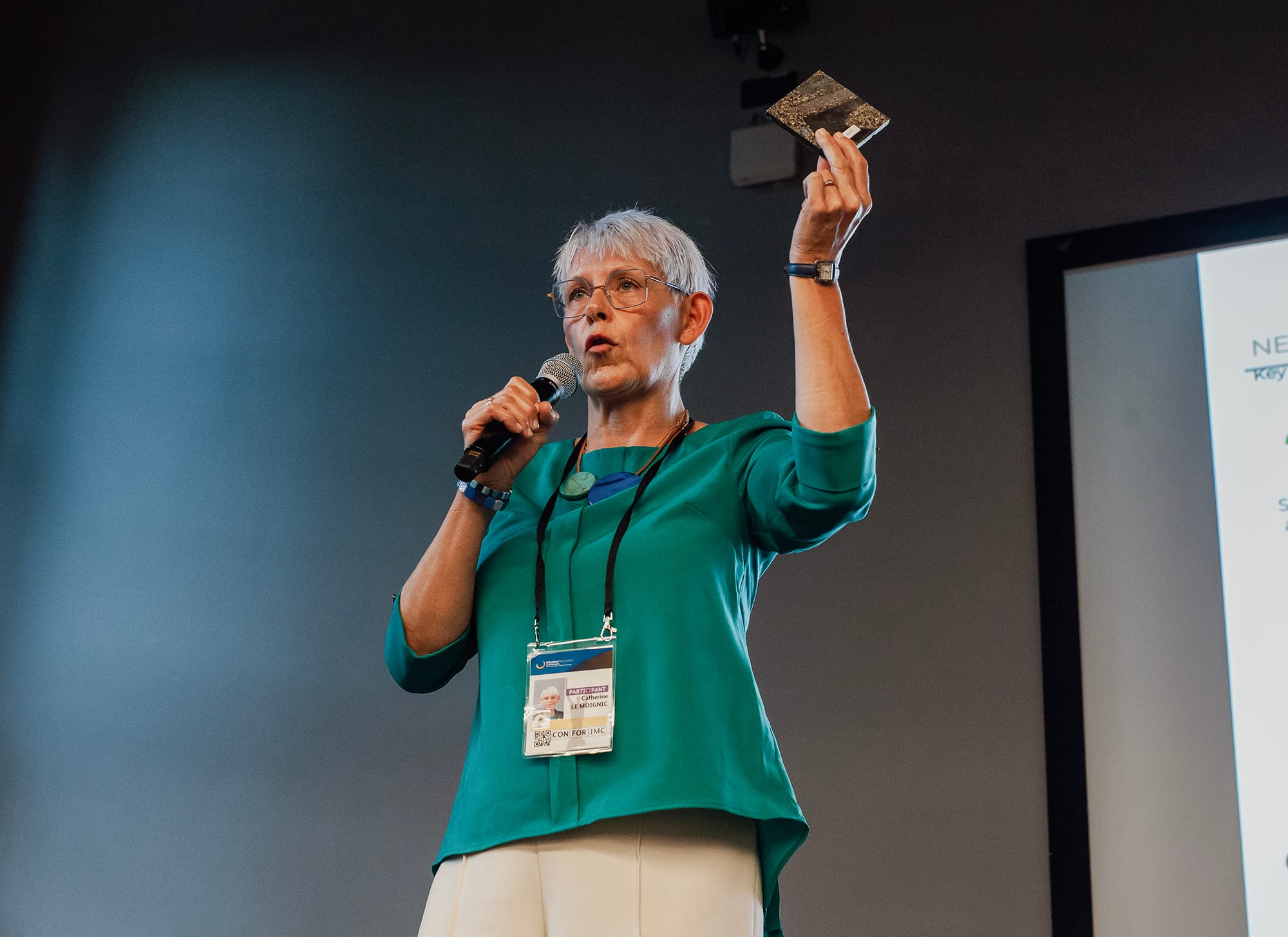
Kate Le Moignic's 5 Tips for Businesses Helping Rebuild Ukraine
#1 - Lose the Corporate Ego
"Humility is very important. We never lose sight of our objective to help Ukrainians rebuild their country for themselves. So you'll find that our communication is less about Neo-Eco Ukraine, and more about supporting the green reconstruction. It's about an innovative, holistic approach with civic engagement that includes vulnerable groups such as children and IDPs and veterans. You'll also notice that individuals are very rarely mentioned – it's all about the team and the people of Ukraine."
#2 - Positivity is Important, Especially in Wartime
"The press was eager to follow a positive story of sustainable reconstruction, with resident engagement, when the news was mainly concentrating on the horror of the hostilities. I believe that our impactful green approach, early entry into Ukraine and the vision of reconstruction by recycling war and construction rubble struck a chord with the media."
"We're also about consistent positive messaging - we think it's key that we post regularly, but when you look the visuals are general, we hope, meaningful with with real people, whether they be residents or team members or MOUs or shaking hands."
#3 - Be Ready to Switch Up Your Social Media Processes
"Many of our Ukrainian partners are not on LinkedIn, which is more tailored to an international audience. I know local executives of international companies who operate solely on Facebook and have no LinkedIn presence. And they prefer Telegram to WhatsApp. Our Facebook page is exclusively in Ukrainian as the platform is more popular in Ukraine there and we’re able to reach the residents and beneficiary communities where we work.
"I also think tagging people and companies is extremely important. And getting in first - for example, for the third anniversary of the war, we've scheduled the post already for 6 am on the 24th of February. If you wake up and start posting at 9 or 10 am, there's already so many posts that yours is going to get lost in the noise. Avoid reposting to show originality and not surf on other people’s content.”
"We get more attention typically when we have partnerships with Ukrainian local authorities, Ukrainian businesses, and, especially residents, children and vulnerable groups.
"When we're seen to be getting our hands dirty in the country, producing results and helping communities, that tends to get the most engagement. But there's spikes and troughs to the engagement."
#4 - Practice Empathy - 'Kyiv, not Kiev'
“Cultural sensitivity and a deep knowledge of the language is always a factor in international communication, but during a war, even more so. At Neo-Eco Ukraine, we try and not only acknowledge, but I would say to 'pay homage to' Ukraine's historical geopolitical sovereignty and their resilience.
"Also pay attention to terminology and the spelling of communities such as Kyiv, Lviv and Odesa. That spelling has changed, and if you don't use the correct spelling now, it's very offensive to the Ukrainian people."
"Also, if we take a word such as ‘conflict’, Ukrainians don't appreciate that, because, the word implies two parties having a disagreement. This is not a conflict. It's an invasion. And Ukrainian's don't consider that the war has lasted three years. It has lasted more than 10. The war didn't start in 2022 - that was the 'full scale invasion' or Ukraine by Russia."
#5 - Get to Ukraine
"At a certain point in time, people need to get their bag ready and jump on a train or a bus and get to Ukraine, meet the people and feel the atmosphere. There's a notion of trust and confidence that can only be built up when you take the time to go to Ukraine. Sitting behind a screen trying to advise Ukrainians, is both limited in its results as well as being perceived as a colonial stance that we don’t agree with
"So my main advice if you want to understand and work with Ukraine, would be to go to the country, or at the very least, ensure you have Ukrainians on your team.”
For questions related to daily news, story suggestions, scoops and other newsy matters, please message URN newsroom chief Valentina Bajic at valentina@ukrainerebuildnews.com.
For sponsorships, the URN Guidebooks, the Tips for Investors column and other general matters, email founder Adam Brown at adam.brown@ukrainerebuildnews.com.
If in doubt, email us both and we'll sort it out.
Now, on with the headlines of the day ...

US envoy arrives in Moscow to seek Russian agreement to 30-day ceasefire
Steve Witkoff, the US envoy assigned to the Ukraine-Russia war, landed in Moscow on Thursday to press talks for a ceasefire, after securing Ukraine's agreement, the Russian news agency Interfax reported, citing "aviation services."
The reported arrival comes after Witkoff joined a delegation in Jeddah Saudi Arabia that met with Ukrainian officials on Tuesday in the first step in a peace process prompted by the United States.
At the Tuesday meeting, Ukraine agreed to a 30-day ceasefire, and the US agreed to resume sharing intelligence with the Ukrainian military and renewed military aid.
In Moscow, the US hopes to get Russian agreement with the ceasefire proposal. As Reuters reported, citing unnamed sources, the Russian side has already haded a list of demands to achieve a deal to end the war.
The officials said the Russian list of demands was "broad" and similar to the country's earlier insistence that Ukraine not be admitted to Nato and that no foreign troops would be deployed in Ukraine. It also demanded international recognition that Crimea and other parts of Ukrainian territory it currently occupied belong to Russia.
"Ukraine is ready for peace. Russia must also show whether it is ready to end the war – or continue it," Ukrainian President Volodymyr Zelensky said in his nightly address to the nation after Ukrainian talks with the US this week.
Witkoff's visit comes a day after Russian President Vladimir Putin visited the Russian area of Kursk, which Ukraine invaded last summer in a push to gain a bargaining chip. The Russians claim to have pushed the Ukrainians out of most of the region.
UK's McGill and Partners rolls out AI-powered war risk reinsurance tool for commercial property in Ukraine
London-based insurance broker McGill and Partners has developed an AI-powered war risk reinsurance facility for commercial property in Ukraine, This is Money reported, citing Hamish Greenwood, head of crisis management at McGill.
The new facility, developed with Ukrainian insurance tech start-up FortuneGuard, uses data on missile strikes to help underwriters assess risks more accurately and offer businesses in Ukraine more affordable premiums, according to the report.
Since the beginning of the war, local insurers in Ukraine have capped coverage cover at $500,000. However, McGill’s new offering will provide coverage of up to $50 million per risk for properties more than 100 kilometers (62 miles) from the front line. Reinsurance capacity will be backed by the London market and Lloyd’s syndicates, McGill said in a January press release.
Since its launch in January, McGill has provided quotes on more than $1.5 billion of cover, Greenwood told This is Money. Warehouses, manufacturing sites, and solar panels are among the assets that could benefit. The facility may also help unlock billions in funding set aside by development agencies for Ukraine.
"The lack of insurance is a real barrier to the deployment of that so we hope that having a program like this can help funds to be released to Ukraine as well," Greenwood said.
Reinsurers have begun working with Ukrainian insurer ARX to facilitate the issuance of quotes, McGill said in the release, adding that access to the reinsurance facility may eventually expanded to other local insurers.
Last December, the EBRD and Aon launched a new €110 million war risk insurance facility that provides guarantees to international reinsurers to cover war-related losses underwritten by local Ukrainian insurance.
Ukraine could import up to 4 bcm of gas this year, and seeks large volumes from the US, exec says
Ukraine could import as much as 4 billion cubic meters (bcm) of gas between April and October as it looks to compensate for production losses amid Russian attacks on the country's gas infrastructure, Dmytro Lyppa, the CEO of LLC Gas TSO of Ukraine, the country's gas transmission system operator, told Reuters in an interview.
Up to half of the gas imported via Europe would come as LNG delivered to European terminals in Germany, Greece, Lithuania, and Poland rather than pipeline gas, and as much of this as possible could come from the US, according to Lyppa.
"If we take the political aspect, it is better for us to bring as much (US LNG) as possible to Poland and gradually bring it to us," Lyppa told Reuters, noting that US LNG could be favored over Qatari LNG, for example, as long as the price difference remains minimal.
Before the latest Russian attacks on the gas infrastructure, Ukraine was producing 52-53 million cubic meters of gas per day. However, a senior industry source told Reuters that production fell by up to 40% due to the attacks, forcing Kyiv to increase imports.
Maxim Timchenko, the CEO of Ukraine's largest private power producer DTEK, told Reuters last month that the company was looking to sign long-term import contracts for LNG in March with US companies Venture Global or Cheniere Energy to supply Ukraine and neighboring Slovakia, Poland and Hungary.
Earlier in February, Ukraine's Foreign Minister Andrii Sybiha said that Ukraine sees "immense" potential in buying and storing LNG from the US after the transit of the Russian gas through the country's territory ended on January 1.
EU carbon tax could lead to $2.7 billion investment loss, $4.7 billion in export loss for Ukraine by 2030, study suggests
Introduction of the EU's Carbon Border Adjustment Mechanism (CBAM) could lead to some $2.7 billion in investment losses for Ukraine between 2026 and 2030, according to an updated estimate from steel industry consultancy GMK Center.
In addition, potential export losses during the same period are projected at $4.7 billion. The estimates are based on 2024 data.
The carbon border tax is the bloc's tool to "put a fair price" on carbon emissions generated during the production of carbon-intensive goods imported into the EU, while also promoting cleaner industrial practices in non-EU countries, according to the European Commission (EC).
The tax is currently in its transition period, which began Oct 1, 2023, and lasts until Jan 1, 2026. During this phase, companies are only required to report their carbon emissions, the EC said on its website.
Ukraine, whose primary trading partner is the EU, exported goods worth $24.8 billion to the bloc in 2024, with 14.5% of these exports falling under CBAM regulations, according to a news release from GMK Center. The economic impact of CBAM is expected to intensify over time, with Ukraine’s GDP potentially losing $1.4 billion in 2026 and further dropping by an estimated $7.25 billion by 2030.
Those projections underscore the urgency for Ukrainian policymakers to develop strategies that would help mitigate the losses, with one possible solution being Article 30.7 of the CBAM Regulation, GMK Center said. The article includes provisions for force majeure exemptions for countries experiencing severe economic and industrial disruptions. Another strategy could involve Ukraine negotiating an updated trade agreement with the EU.
Last month, the European Commission proposed further adjustments to simplify CBAM and cut red tape as part of the first Omnibus package, according to an EC release. These changes include exemptions for small importers, more flexible emissions reporting requirements, reduced frequency of CBAM certificate purchases, and extended declaration deadlines, among others.
Norway allocates €16 million to Nordic Green Bank for Ukraine's rebuilding
Norway will provide €16 million to the Nordic Green Bank (NEFCO) to support Ukraine's reconstruction and green recovery, the development finance institution said.
The funding will mainly support energy-efficiency projects, such as renovating schools and hospitals, upgrading wastewater facilities, and installing solar energy solutions.
Some of the funds have already been used for technical assistance in building urgent housing for internally displaced persons and developing near-zero-energy school projects, NEFCO said in a press release earlier this week.
The funding is part of the Nansen Support Programme for Ukraine, a Norwegian initiative with a NOK 205 billion (€17.7 billion) budget for 2023–2030, aimed at rebuilding Ukraine's infrastructure and enhancing resilience by cutting energy consumption.
The Nansen program is a Norwegian support program for both civilian and military aid for Ukraine. In December 2024, both the budget and the duration of the program were extended, and in March, the budget was further increased by NOK 50 billion.
NEFCO is an international finance institution established by the Nordic governments of Denmark, Finland, Iceland, Norway, and Sweden in 1990.
Turkish trade, agriculture ministers to meet Zelensky in Kyiv to discuss reconstruction
Turkey's Trade Minister Ömer Bolat and Agriculture and Forestry Minister İbrahim Yumaklı, accompanied by representatives from the Turkish Contractors Association and 25 Turkish construction companies, are set to visit Kyiv, Turkish news outlets reported, citing the Trade Ministry.
During the visit, the ministers will meet with President Volodymyr Zelensky and hold discussions on Turkey’s role in rebuilding Ukraine’s war-damaged infrastructure, with a particular focus on construction.
Yumaklı will also address the rebuilding of Ukraine’s agricultural irrigation systems and discuss lifting existing export restrictions on dairy products and poultry.
Bolat and Ukraine’s Minister for Development of Communities and Territories, Oleksii Kuleba, will co-chair the inaugural meeting of the Turkey-Ukraine Reconstruction Task Force, as reported by Hürriyet Daily News, Turkiye Today, Anadolu Agency.
The task force, established in January 2024, identified the restoration of Ukraine's roads, bridges, railways, water transport infrastructure, protection of critical infrastructure, and housing reconstruction as well as aviation as key areas of collaboration. Earlier, the two countries signed a memorandum of understanding on Ukraine's reconstruction.
The Turkish construction industry has already undertaken 100 emergency projects valued at $1.2 billion, covering key sectors such as highways, bridges, energy, and housing, according to the reports. With an accumulated project portfolio in Ukraine estimated at $10 billion, the sector is poised to play a crucial role in meeting Ukraine’s urgent needs and contributing to its post-war recovery.
In 2023, trade between the two countries totaled $6.2 billion. Ukraine's Economy Minister Yulia Svyrydenko said during a Turkey-Ukraine Business Roundtable Meeting in Ankara that the countries are targeting "$10 billion of balanced trade."
Netherlands Enterprise Agency awards €4 million grant for construction of 400 bio-based houses in Ukraine
The Netherlands Enterprise Agency (RVO) has awarded a €4 million grant to a consortium of Rawblox, Hempire UA, and OpenDoorUkraine.NL for the construction of 400 bio-based, circular houses in Ukraine over the next four years.
The 60 sqm houses will be based on hybrid straw and hemp technologies and will be built for Ukrainian rural families affected by the war with Russia, with the project expected to start on May 1.
OpenDoorUkraine.NL said in a press release on Wednesday that the project will prioritize sustainability, affordability, and efficiency, including lower construction costs compared to traditional methods, up to a 60% reduction in energy bills for homeowners, locally sourced materials, and adherence to EU standards on energy-efficient, CO2-neutral construction, among others.
By setting up production lines in Ukraine and using locally sourced raw materials, this initiative will provide essential housing while also boosting the local economy, according to OpenDoorUkraine.NL. Each home will require five tons of locally grown straw and hemp, creating new income opportunities for farmers.

OpenDoorUkraine.NL noted that recent research by Ukrainian architect Alexander Kucheravy further highlighted the potential of bio-based technologies as the most energy-efficient.
Kucheravy said in a post on LinkedIn that the planned housing units were designed to address Post-Traumatic Stress Disorder (PTSD).
OpenDoorUkraine.NL is a Netherlands-based public platform that supports businesses, humanitarian organizations, and civil society actors working with Ukraine.
The Netherlands-based Rawbox makes pre-fabricated construction systems used to build houses made almost entirely from straw.
Ukraine-based Hempire UA is the only certified Ukrainian manufacturer of binders for hemp-lime insulation applications, it says on its website.

Former Ukrainian PM: Ukraine's economic recovery depends on industrial development
Ukraine's economy will not recover to its pre-war levels unless the country starts taking measures to strengthen its production and work on industrial development, Anatoliy Kinakh, who served as Ukraine's Prime Minister between 2001-2002 and is the leader of the Party of Industrialists and Entrepreneurs of Ukraine, wrote in an op-ed for GMK Center.
Kinakh emphasized the need for the government to develop an action plan to revive the economy, with a focus on accelerating the implementation of the "Made in Ukraine" state policy, strengthening parliamentary oversight and ensuring cooperation between the Verkhovna Rada, the Cabinet of Ministers, and the National Bank, stimulating industrial production and the real economy, and enhancing tax and customs policies to support entrepreneurship.
bne IntelliNews: CEE infrastructure poised to play key role in Ukraine's reconstruction
Central and Eastern Europe's infrastructure capabilities will play a crucial role in Ukraine's post-war reconstruction and the countries in the region must take steps to improve their highways, rail networks, ports, energy, renewables, and digital infrastructure to respond to the challenge, Jozef Hrabina, a geopolitical risk consultant and founder of GeopoLytics, wrote in an op-ed for bne IntelliNews.
CEE faces an estimated infrastructure gap of over €500 billion compared to Western Europe, Hrabina wrote, arguing the region must modernize its financing mechanisms and that the global investment community must grasp the urgency and opportunity in CEE infrastructure in order for the region to be able to deliver its part in Ukraine's rebuilding.

Ukraine must explore alternative strategies for financial sustainability amid declining foreign aid, CEPR says
Ukraine must consider alternative strategies to ensure long-term financial sustainability and secure its defense capabilities amid the prospects of a reduction in foreign aid, the Centre for Economic Policy Research (CEPR) said in a recent policy paper.
According to CEPR, these measures could involve mobilizing domestic resources, leveraging Russian frozen assets, and adopting policies aimed at boosting productive capacity, tackling fiscal and trade deficits, and fostering economic resilience.
The paper identified three key challenges facing Ukraine's wartime economy: limited productive capacity, large fiscal deficits, and significant trade imbalances. Ukraine's productive capacity has been hampered by the destruction of infrastructure, labor shortages, and frequent power outages due to Russian attacks, CEPR noted.
Meanwhile, Ukraine's fiscal deficit, projected to be around 19% of GDP in 2025, continues to rely heavily on foreign aid to fund military expenditures and essential government services. Finally, the ongoing war has led to a persistent trade deficit, exacerbated by blockades and the destruction of vital industries.
CEPR highlighted the urgent need for Ukraine to address these issues through targeted economic policies that prioritize supply-side growth, fiscal discipline, and strategic trade adjustments.
To address Ukraine's productive capacity, the paper proposes a multifaceted strategy focused on overcoming logistical bottlenecks, ensuring a stable electricity supply, and fostering labor market participation.
On the fiscal front, the paper emphasizes the need for Ukraine to raise taxes and control non-defense spending in order to reduce its dependence on foreign aid. Although raising taxes is politically and socially challenging, the report suggests that consumption taxes, progressive income taxes, and closing tax loopholes can help generate much-needed revenue.
Regarding trade imbalances, Ukraine's persistent trade deficit is exacerbated by the ongoing war, which has hampered exports and increased the need for imports. The CEPR paper proposes a gradual adjustment of the hryvnia's exchange rate to improve the trade balance and stimulate economic activity. Additionally, the use of capital controls and efforts to reduce export bottlenecks, such as enhancing the capacity of seaports and land-based routes, are proposed as measures to stabilize the economy.
Ukraine's war economy also faces the challenge of financing its deficits without external aid. CEPR stresses that Ukraine needs to tap into alternative sources of funding, such as government bonds, and incentivize the private sector to channel its savings into these bonds. While options like printing money are cautioned against due to the risk of inflation and long-term economic instability, the paper suggests that strategic debt management and efforts to attract domestic and foreign investment are essential for maintaining financial stability.
In conclusion, CEPR said that while foreign aid has been critical to Ukraine’s survival, the country must prepare for the possibility of reduced support. The European Union and other allies should continue to provide assistance, but Ukraine must simultaneously adopt policies that promote self-sufficiency, mobilize domestic resources, and strengthen its economy in the face of prolonged war.

Call for Investment Projects Ahead of URC
The Kyiv School of Economics announced the opening of calls for Ukrainian companies to submit investment projects for the Ukraine Recovery Conference 2025, to be held in Rome in July. The KSE is coordinating the call along with Ukraine's Economy Ministry.
URC "will bring together hundreds of international investors, government officials, business leaders, and financial institutions to support Ukraine’s economic recovery," the post says. "Ukrainian companies now have the opportunity to showcase their projects, attract global partners, and secure funding for growth and development."
Ukreximbank Meets Japanese Businesses on JUPITeR
Ukreximbank, the State Export-Import Bank of Ukraine, recapped a meeting with a delegation of Japanese businesses and government officials organized to expand use of the Japan-Ukraine Platform on the Infrastructure Technology for Recovery and Reconstruction (JUPITeR).
"Executives from 15 Japanese companies, all JUPITeR participants, showcased their businesses and discussed current and prospective projects along with innovative solutions to support Ukraine’s infrastructure recovery. Both parties agreed to organise an interactive meeting with a broader range of Japanese companies participating in the JUPITeR platform."
Furniture and Paper Top ECA-Supported Exports
Ukrainian Economy Minister Yulia Svyrydenko posted that furniture, paper & cardboard and plastics from Khmelnytskyi, Zaporizhzhia and Ternopil led exports in the first two months of this year supported by the Ukrainian Export Credit Agency (ECA).
In all, the ECA supported UAH 1.79 billion ($43 million) worth of exports, providing insurance for UAH 72.96 million in bank financing for Ukrainian businesses, she wrote. France, Germany, Bulgaria, Denmark and Hungary were the leading export destinations.
airBaltic Ready to Resume Flights to Ukraine
Serhiy Derkach, deputy minister for Communities, Territories and Infrastructure Development of Ukraine, recapped a meeting with airBaltic management, who expressed their readiness to resume flights to Ukraine when conditions allow.
"Our current priority in the civil aviation sector is to preserve the personnel and the suitability of the airport infrastructure and ensure the stable functioning of air navigation. At the same time, safety is the key to opening airspace. Without creating a safe environment, such decisions are impossible."
French Medical Education for Ukrainians
Deputy Health Minister Edem Adamov recapped a visit to French university hospitals and simulation centers, used in teaching medical procedures, to find ways to upgrade the Ukrainian health system.
"Starting in 2026, Toulouse is ready to welcome Ukrainian students for internships. This is a unique opportunity to study according to advanced standards and gain experience in Europe’s top clinics."

URN Daily: Sense Bank and Ukrgasbank for sale? And US seeks to cancel $4.7 billion of Ukraine's debt