
Contents
Reporter's Notepad: Rebuild Ukraine, one of the biggest formal events of the year related to the reconstruction of Ukraine, kicks off Wednesday in Warsaw. For the first time, the event now hosts a European Union-Ukraine Investment Conference segment, with plans to cover the early results of the EU's Ukraine Investment Framework. URN Daily will be there.
Just The Facts: Economy Minister Yulia Svyrydenko says her government plans to transform Ukraine's economy through the production of value-added goods, Indian exporters of processed metal goods, machinery and other items forecast a demand boom next year from the reconstruction of Ukraine, and Finland will provide up to €50 million in loans to Ukraine in 2025 for reconstruction projects financed under the Finnish-Ukrainian Investment Fund.
Here's What They Think: A Trump administration in the US may actually heighten pressure on Russia's President Vladimir Putin, says an op-ed piece in The Conversation, while The Guardian writes that Joe Biden should use his remaining weeks as US president to get a peace deal done in Ukraine.
Sober Second Thought: Besides their primary aim, Ukrainian state-owned enterprises (SOEs) serve as instruments for state regulation, exemplified by entities such as Ukroboronprom, a conglomerate in various sectors of Ukraine's defense industry, according to a new study.
The Rebuilder's Social: Kyiv School of Economics President Tymofiy Mylovanov denies rumors that he will be appointed as Ukraine's ambassador to the United States, Ukrhydroenergo says Voith Group will train its engineers in Austria with German government backing, and UNDP Ukraine and the government of Japan are training female tractor drivers in Ukraine's Vinnytsia Oblast.

Dear subscribers,
Rebuild Ukraine, one of the biggest formal events of the year related to the reconstruction of Ukraine, kicks off Wednesday in Warsaw. For the first time, the event now hosts a European Union-Ukraine Investment Conference segment, with plans to cover the early results of the EU's Ukraine Investment Framework. URN Daily is there.
As the time of this writing, the opening press conference has just ended, with a few noteworthy details:
- Gert Jan Koopman, director general for neighborhood policy and enlargement negotiations at the European Commission, announced that "literally the moment I complete my speech, we will be launching a new call for expressions of interest from EU-based businesses to invest in Ukraine."
He called it "a bold new step we're taking which makes it possible for companies established in the EU to directly submit their investment ideas and projects to the European Commission. We will then be assessing this, looking at this, discussing it with you. The idea is to build a pipeline of transformative private investments that can contribute to Ukraine's recovery and reconstruction."
- Ukrainian Deputy Economy Minister Oleksii Sobolev said that new mechanisms in the style of war-risk insurance will be announced at the two-day conference
- Ukrainian Energy Minister German Galuschenko, responding to a question about whether the flow of money from the US will stop after the US election, said he is "absolutely sure" US aid to the energy sector will continue
- Anatoly Sushon, chairman of conference organizer Premier Expo, said the exhibition this year has drawn 538 exhibitors from 32 countries, plus 17 Ukrainian communities that are presenting 129 projects. (Last year drew 557 exhibitors)

EU foreign policy nominee calls for direct use of Russian assets to fund Ukraine recovery
Kaja Kallas, the former Estonian prime minister and current nominee for high representative of the European Union for foreign affairs and security policy, has proposed using the $300 billion in frozen Russian assets to help fund Ukraine's reconstruction, Bloomberg reported.
During her confirmation hearing, Kallas emphasized Ukraine's "legitimate claim" to the funds after being attacked by Russia. "I will not use the word confiscation, because it's really using the assets in a legal way," she told the bloc lawmakers.
"We recognize that Russia has a legitimate claim toward us, because we have their assets," Kallas clarified, adding: "But Ukraine also has a legitimate claim toward Russia because, every day, they are destroying Ukraine."
Kallas recommended that sanctions against Russia should not be subject to renewal every six months, and should instead remain indefinitely until the 27 members opt to lift them.
The G7 forged an agreement to access profits generated from frozen Russian central bank assets, while putting aside the option of more direct measures. Some countries have considered the legal risks and potential impact of direct measures on the euro, while others — including US and UK — have advocated for bolder measures, such as direct asset seizures.
Ukraine aims to transform economy by boosting value-added production, economy minister says
Ukraine's government aims to enhance domestic value-added production to transform its commodity-based economy, increase revenue, drive growth, and encourage millions of Ukrainians to return home, the country's Economy Minister Yulia Svyrydenko told Reuters in an interview.
"The task is to move away from the economy of raw materials and to build the economy that produces goods with added value," Svyrydenko stated. "We face challenges to accelerate growth because we need to rebuild and also integrate into the European Union."
The government has already launched several programs offering grants and loans to small and medium-sized businesses and created dozens of industrial parks with specialized fiscal measures.
"Our task is to support more Ukrainian production and also support the consumption of Ukrainian-produced goods," the minister told Reuters.
The government has lifted its forecast for Ukraine's GDP growth this year to 4% from an earlier estimate of 3.5% due to better preparedness for energy sector challenges, Svyrydenko said, adding the government's conservative scenario for 2025 envisages a 2.7% economic growth.
Svyrydenko also recalled that the World Bank and other partners were working on a new damage assessment of the war in Ukraine. The last assessment, published in February, placed Ukraine's recovery cost at $486 billion. That figure is "2.8 times higher than our nominal GDP in 2023," Svyrydenko noted.
Despite economic growth in 2023 and so far in 2024, the Ukrainian economy was still only at 78% of its size before the Russian full-scale invasion in February 2022, according to Svyrydenko.
The key goal now was to make the Ukrainian economy more self-sufficient. "From every hryvnia consumed in Ukraine, 40% is returning to the budget ... and it is the issue not only of economic self-sufficiency but also our defense capacity," the minister said.
Trump's skepticism could complicate IMF cooperation with Ukraine, sources warn
The International Monetary Fund (IMF)'s $15.6 billion program with Ukraine — spanning from 2023 to 2027 — has been progressing smoothly so far, but future cooperation may face challenges following Donald J. Trump's re-election, RBC Ukraine reported, citing unnamed government sources.
One source warned that the IMF is likely to become more cautious, while another said: "We are getting clear signals that it will become more difficult." The concerns stem from the US administration under Trump, who is skeptical about support for Ukraine. The US is IMF's largest shareholder with nearly 17% of voting power and the ability to veto board decisions.
However, Vitali Vavryshchuk, head of the macroeconomic research department at ICU Group, believes these concerns may be premature. He argued: "I think these assumptions are speculative, similar to the idea that the Trump team might initiate peace talks with Russia. At this point, there is no evidence that US foreign policy toward Ukraine would drastically change."
Vavryshchuk did not rule out the potential push from the US for stricter tax policies in Ukraine. This could translate to lenders pushing Ukraine to raise domestic revenue. The IMF program already includes provisions for potential Value Added Tax hikes in 2025 to compensate for any potential funding shortfalls.
On Monday, the IMF started the sixth review of its loan arrangement with Ukraine.
88% of Ukrainians believe Ukraine will win the war, survey finds
88% of Ukrainians believe their country will end up the winner in the war with Russia, a survey conducted by the US-based nonprofit organization International Republican Institute (IRI).
"Ukrainians continue to believe in the current military campaign and are confident that they can achieve a victory over Russia," IRI Senior Director for Euroasia Stephen Nix said in a press release on Tuesday.
The survey also indicated that 71% of adults support the government reclaiming all lost territory. Additionally, 64% of Ukrainians are prepared to bear a greater share of the war effort via a raise in the military tax to 5% from 1.5%.
"The data shows that Ukrainians want to live within the 1991 borders and are willing to pay more in taxes to push Putin's forces out of the country," Nix stated.
Asked how they see the future of Ukraine, 78% of respondents said the future is rather promising, while 15% said rather hopeless, according to the study.
Participants in the survey were also asked to compare their households' economic situation with the pre-full scale invasion period. To this question, 37% responded that the situation has worsened somewhat, 31% said it has worsened a lot, while 25% said it stayed the same.
43% of the respondents said the economic situation of their households will stay the same in the next 12 months, 19% said it will worsen somewhat, 13% said it will improve a lot, and 11% said it will worsen a lot.
The survey, funded by the United States Agency for International Development (USAID), was conducted between Sept. 27 – Oct. 1 across Ukraine, except for Crimea and Donbas, through computer-assisted telephone interviews. The total sample consists of 2,000 Ukrainians aged 18 and older. The response rate was 7%.
Finland to lend €50 million to Ukraine for reconstruction projects
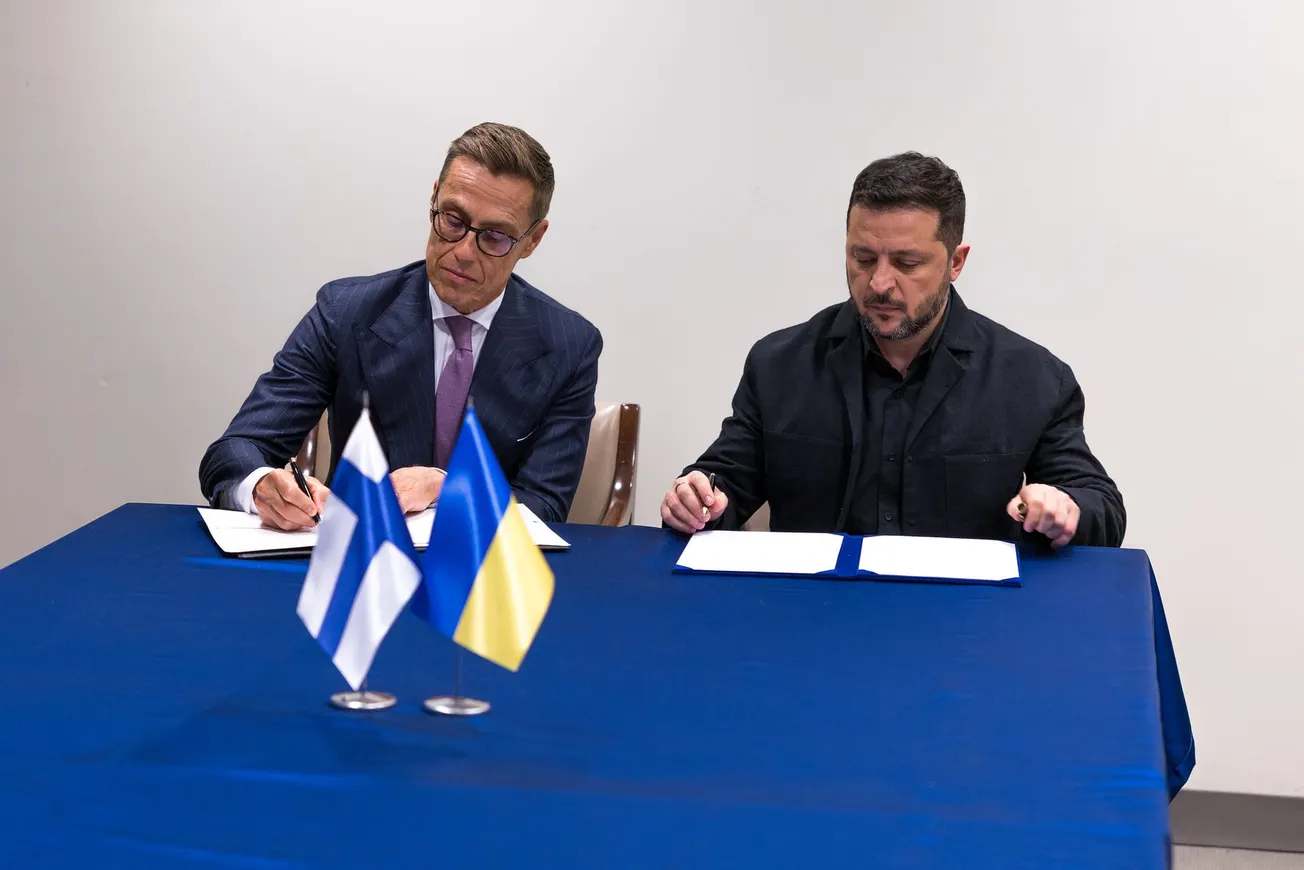
Finland will provide up to €50 million in loans to Ukraine in 2025 for reconstruction projects financed under the Finnish-Ukrainian Investment Fund (FUIF).
Finland's Foreign Trade and Development Minister Ville Tavio and Ukraine's Finance Minister Sergii Marchenko on Tuesday signed a framework agreement on the funding, Ukraine's finance ministry said in a press release.
The grant component of the program will amount to at least 35% of the total cost, which will allow for concessional financing terms, according to the ministry.
The Finish government said in a separate statement that Finland will also support Ukraine's education sector with €20 million in 2025–2028. The bilateral project between Finland and Ukraine will focus on implementing general upper secondary education reform.
Since February 2022, Finland's direct budget support to Ukraine has surpassed $36 million in grant funding, Ukraine's finance ministry noted.
According to the Kiel Institute for the World Economy, Finland is the fifth largest donor of military, humanitarian, and financial assistance to Ukraine in terms of its GDP share, amounting to about €2.5 billion or 0.9% of GDP, the ministry said.
India's Engineering Export Promotion Council predicts surge in demand due to Ukraine's reconstruction
India's Engineering Export Promotion Council (EEPC), which represents exporters and manufacturers of metal goods, machinery and other products, anticipates a surge in demand soon from the reconstruction of Ukraine, EEPC Chairman Arun Garodia said at a press conference on Tuesday, the Hindu Business Line reported.
"Ukraine wants to buy from us; Russia also wants to buy from us," Garodia said, expressing hope that the war in Ukraine will end soon after Donald Trump becomes the US president. He said India has maintained friendly relations with both Ukraine and Russia.
Asked whether the EEPC had begun preparations for the Ukraine push, Gadoria said some discussions had already taken place.
He also said that India's exports of engineering goods, including metals like steel and aluminum, would surpass $118 billion in 2024-25, and could even go as high as $125 billion, compared with $109 billion in 2023-24.
India's government has set a target of $300 billion for 2030 and $1.5 trillion for 2047 for engineering exports. Garodia said that even though the targets were set high, they were not unrealistic.
Garodia stated the government had fixed the targets after consultations with the industry. The emerging sectors such as renewable energy, and electric vehicles, provided room for growth, let alone opportunities arising from Ukraine and Russia, according to Garodia.
EEPC is the largest export promotion council in India. Established in 1955 under India's Commerce Ministry, its membership counts around 13,000 Indian engineering firms from SMEs to large corporates, according to its website.
Green Flag Ventures sees Trump election as 'net positive' to its Ukraine portfolio
Green Flag Ventures, a US-based venture capital fund that invests in early-stage Ukrainian dual use and military technology startups, sees last week's US election outcome as a "net positive" for its Ukraine portfolio and the counrtry's role as a technology hub.
"We assess with high confidence that the outcome of U.S. elections will accelerate the trends Green Flag Ventures originally bet on: heightened Ukrainian innovation, growing European defense self-reliance, and increased global investment in Ukrainian technology," management wrote in a letter to limited partners.
"In essence, we anticipate a net positive impact on Green Flag Ventures’ investment thesis," said the letter, which was forwarded to Ukraine Rebuild Newswire.
Green Flag Ventures, which has invested in Kara Dag Technologies, Himera, Swarmer and AstraNav, is one of the first firms involved in Ukraine to publicly assess the outcome of the historic US election, which has left companies, politicians and organizations in Ukraine awaiting the early moves of the Trump administration in regards to Ukraine.
Green Flag Ventures assesses that Ukraine will retain its sovereignty in any peace agreement, that the European Union recognizes the "urgent" need for defense investment and that Russia is facing "severe economic strain." It also predicts Ukraine will retain its leading role in innovation in European defense.
Also, Ukraine has grown tired of the "aid drip" policy of the outgoing US administration and is ready for deeper relationships with Europe as well as, possibly, with the Trump administration, depending on the new government's policies, according to the letter.
"The growth in European defense spending, Ukraine’s resilience and tech-driven innovation, and Russia’s economic limitations collectively create a favorable environment for our portfolio companies," Green Flag wrote. "A sovereign Ukraine, strengthened in any peace deal, will reinforce its role as Europe’s dominant hub for dual-use technology and innovation."
Longer reads
New forest emerges from destruction of Ukraine's Kakhovka dam
Young forests have started emerging in part of the Kakhovka dam reservoir in Ukraine which was left dry after the dam was destroyed in a Russian bombing in June 2023, The Revelator reported Tuesday.
Following the attack on the 3 km-long dam in southern Ukraine, the dam's waters flooded the plains, claiming hundreds of civilian lives, wiping out countless livestock, devastating farms, and displacing residents from over 37,000 homes.
Researchers from Ukrainian ministries and independent organizations found that the attack had flooded about 60,000 hectares (230 square miles) of forest in at least four national parks, threatening an estimated population of 20,000 animals and 10,000 birds, the report said.
"Almost all aquatic vegetation had died, and much of the marine life had disappeared, including mollusks," said Serhiiy Skoryk, director of Kamianska Sich National Park in Kherson, one of the regions affected. "Those that survived moved downstream," he added.
A report from the Ukrainian Scientific Center for Marine Ecology, released just months after the dam's destruction, also revealed significant pollution in the Black Sea, including heavy metals like copper, zinc, and arsenic compounds.
A Ukrainian Nature Conservation Group study highlighted that wildlife across 5,000 square kilometers (1,930 square miles) suffered devastating impacts from the flood, affecting rare species of birds, mammals, reptiles, and insects. "Populations of some species were dealt a possibly greater blow in one day on June 6 than in the last 100 years," the authors wrote.
However, an unexpected development has emerged amid the devastation.
"Despite the challenges, our colleagues have been making regular expeditions to the affected area," said Oleksiy Vasyliuk, an environmental scientist from Ukraine who has been documenting the ecological impact of the war. "Three months after the attack they were shocked to find vegetation and forests in part of the reservoir that was left dry after the dam collapse."
The scientists documented a young willow forest arising from the dry cracked soil left behind by the floods. "It was unbelievable; no one expected to see the greenery they found, or that such a thing could happen amidst these tragic events," Vasyliuk stated.
Where desertification was once feared, a dense forest primarily of willow trees now covers approximately 150,000 hectares (930 square miles) of land that was formerly submerged by the reservoir, with some trees reaching heights of six meters.
Vasyliuk suggested that, even without fertile soil, the forest thrived due to the organic matter left by the deceased animals and plants, including species like mollusks.
The forest was the "only good thing to happen since the Russian attacks have damaged much of the local environment," Vasyliuk noted.

The Conversation: Trump White House may end up increasing pressure on Putin
A Donald Trump administration in the US may actually heighten pressure on Russia's President Vladimir Putin, Affiliate Professor at the Institute for Russian, European, and Eurasian Studies at the University of South Florida Tatsiana Kulakevich wrote in an op-ed for The Conversation.
Kulakevich gave three arguments to support her stance. First, she wrote that Trump's portrayal as isolationist, nationalistic, and anti-interventionist on the world stage was not backed up by established facts and prior Republican positions.
She gave an example of bipartisan legislation prohibiting a president from unilaterally withdrawing the US from NATO that the US Congress passed in December 2023, among others.
Further, Kulakevich argued that Trump's relationship with Putin is not as "cozy" as often described. For example, Trump provided Ukraine with anti-tank missiles after the Obama administration refused. In addition, the US in 2018 withdrew from the Intermediate-Range Nuclear Forces Treaty, citing the previous violations of the treaty by Russia, Kulakevich wrote.
Finally, Trump has repeatedly made promises to launch a new wave of drilling for oil and gas on American soil, which could harm Russian interests as "the Kremlin's war machine still runs on energy revenues," Kulakevich noted.
The Guardian: What should Biden do with his remaining time? Get a peace deal done in Ukraine
The US is currently in talks with Russia through president-elect Donald Trump, who, according to an op-ed piece by Guardian columnist Simon Jenkins, is a known admirer of Russia and sceptic of US support for Ukraine.
Russian President Vladimir Putin's attempt to topple Ukrainian President Volodymyr Zelensky has failed, and negotiations have faltered, with Western leaders encouraging Ukraine to fight on in a proxy war against Moscow, the piece says.
Additionally, Western sanctions have proven ineffective in shifting Russian policy, resulting in a stalemate in negotiations, Jensen says. The impacts of sanctions have been felt more in Western economies, which grappled with inflation, especially energy prices. Negotiations remain the only realistic pathway for ending the war, and the choice lies with the US, Jenkins argues.
As US President Joe Biden approaches the end of his presidency, he must be eager to end at least one of his wars, before uncertainties from Trump's second term arise, Jenkins concludes, suggesting that the US should seize the moment and push for negotiations before the situation becomes more complicated.

State control over key sectors in Ukraine proved beneficial in war time, study finds
Besides their primary aim, Ukrainian state-owned enterprises (SOEs) serve as instruments for state regulation, exemplified by entities such as Ukroboronprom, a conglomerate in various sectors of Ukraine's defense industry. This dual role of SOEs extends beyond production and into economic steering, Jiří Blažek and Anton Lypianin from Prague's Charles University wrote in a study published by De Gruyter on Tuesday.
The escalation of Russian military aggression since 2014 spurred deeper government intervention in Ukraine's economy. Industries tied to defense and aerospace, backed by state support, outperformed those in other sectors, according to the authors. From 2010–2013, private firms in these sectors captured more value than SOEs.
However, between 2016–2020, SOEs narrowed this gap, emerging as the only group to see value capture gains. This shift reflects Ukraine's strategic allocation of limited resources, with SOEs in defense and aerospace receiving priority, signaling the uneven nature of government support across industries, the pair wrote.
The abrupt geopolitical break from Russian markets in 2014 caused a significant drop in both exports and imports for Ukrainian industries. However, the relatively smaller drop in exports emphasized the necessity for Ukrainian firms to sustain revenues and their exporter status.
Differences emerged based on firms' positions within production networks; lead firms and Tier 1 suppliers managed to preserve a larger portion of their export operations, while lower-tier suppliers pivoted to supply Ukrainian markets, the study found.
Since 2014, and especially after the full-scale invasion in 2022, Ukraine's leadership has accrued significant expertise in economic management under crisis conditions. Strong state ownership in critical sectors proved advantageous, and the adaptation of firms to replace Russian imports with domestic sources demonstrated economic resilience.
This capability became even more apparent after 2022, as Ukraine accelerated the production of drones and other defense technologies, often incorporating AI.
Finally, the research highlights key geopolitical insights.
First, robust economic ties are not necessarily a deterrent to conflict, it found. Second, military confrontations do not always halt trade entirely, exemplified by Russia's continued payment for oil transport through Ukraine's Druzhba pipeline despite active warfare. Moving forward, maintaining international law and pursuing peaceful solutions will be vital for global stability, the study concludes.

Tymofiy Mylovanov, president of the Kyiv School of Economics, denied rumors that he will be appointed as Ukraine's ambassador to the United States. "It's simply not true," he said, adding that his goals center on his work at KSE.
Ukrhydroenergo, the state hydro power generator, said that Voith Group, which makes turbines and generators, plans to train Ukrhydroenergo engineers "on a wide range of topics: turbine, generator, excitation system, control system, and hydropower plants in general." The training is backed by the German government.
Economy Minister Yulia Svyrydenko announced the launch, with Google Ukraine and the Ministry of Digital Transformation of Ukraine, of an "AI Training Platform to equip Ukrainian entrepreneurs with the skills needed to thrive in a digital economy."
UNDP Ukraine and the government of Japan have started training female tractor drivers in Ukraine's Vinnytsia Oblast. By May 2025, 15 women will receive A1 and A2 category driving licences and certificates as tractor drivers.
The Ministry of Finance of Ukraine announced the sale of domestic government bonds worth UAH 26.5 billion in a post on LinkedIn.