
Contents
Reporter's Notepad: Lisa Kaestner of the IFC details two key shifts in the IFC's Ukraine policy - one she is seeing and one she wants to see soon. And Oliver Gierlichs, CFO of Bayer in Ukraine, offers advice to government on how to attract companies despite the ongoing war.
Just The Facts: Zelensky says the war will end "sooner" with the Trump team in the White House. Biden reportedly allows Ukraine to strike deep into Russia with US weapons. The US and Ukraine are cooperating on three small modular reactor projects worth $30 million, and Russia attacks Ukraine's energy infrastructure in 'massive' air strike.
Here's What They Think: Russia's massive missile and drone attack on Ukraine's energy infrastructure on Sunday signals that the end to the war appears a "long way off," the Guardian writes
Sober Second Thought: Job seekers in Ukraine see a lack of local job opportunities and low salaries as the main challenges they face in the labor market, research conducted by the International Organization for Migration (IOM) revealed.
The Rebuilder's Social: The ReBuild Ukraine event in Warsaw continued to dominate the social media chatter related to the reconstruction of Ukraine, with related posts by AHK Ukraine, senior adviser at the British Embassy in Kyiv, Adam Mycyk from Denton's, Ukrhydroenergo, and dozens, or perhaps hundreds, of others.

Dear subscribers,
The International Finance Corporation's financing for Ukraine is undergoing a key change due to the organization's partnership with the European Commission on the Ukraine Investment Framework, said Lisa Kaestner, the IFC's Ukraine regional manager.
The change, she told a workshop hosted by the EC in Warsaw last Thursday, is a shift away from short-term trade-oriented financing toward longer-term "riskier investments" that involve capital expenditures.
"With the engagement now with the Ukraine investment facility, we're looking at a pipeline with more capital expenditures, riskier investments that we're able to undertake now thanks to the de-risking tool that's provided by the Ukraine Investment Framework," she said.
"So we have a pipeline now that we're looking at about a billion dollars for the next 12 months, which is largely in infrastructure."
A second shift, though, "we're not quite seeing yet." And that's the shift, toward working with companies new to Ukraine.
"Most of the investment we've been able to do in Ukraine, the $1.8 billion, has been with existing clients and with companies that are already in Ukraine," she said. "We would really like to see new partners coming into Ukraine.
She also said the IFC is "able to partner with companies on helping them develop their business idea in Ukraine.
"We've been in the market for 30 years. We know the players. We know the regulatory issues. We can engage also with the public sector on regulatory issues. So if there's a investor that's looking to come through the outreach of our EC colleagues to Ukraine, we're ready to also support on the advisory side to help them develop a project that could be viable in Ukraine."
Oliver Gierlichs, CFO at Bayer in Ukraine, called on the government to offer clear incentives to companies who set up in Ukraine before the end of the war rather than wait until it's over.
"Mid-sized companies don't have this financial backbone. If they lose a plant, they probably have financial problems and maybe even bankruptcy. So what you need to do is to tell them: 'if you come now during the war, you have an incentive, you have an advantage, compared to those who come later after martial law is over.' This is a crucial thing for many."
Gierlichs spoke on the same panel as the IFC's Kaestner last Thursday. The panel also included other companies who, like Bayer, announced investments in Ukraine while the war is ongoing, including Kingspan and Neo-Eco.
"This financial advantage compared to competitors that will come later is something you cannot miss," Gierlichs said. "So companies that come now don't pay certain corporate tax, for example, for this period of martial law plus three or five years. That makes a decision easier. If the first company comes in, the competitors will say, we don't go in."
He made the comments sitting next to senior Ukrainian government figures but received no direct response.
Deputy Minister of Economy Oleksii Sobolev, however, did later in the day repeat a statement he made earlier that the government plans to beef up UkraineInvest, the government investment promotion agency, and give it new powers.

Trump's election could end war in Ukraine 'sooner,' Zelensky says
Donald Trump's election victory could lead to an earlier-than-expected end to the war in Ukraine, Ukrainian President Volodymyr Zelensky said in an interview with Ukrainian state broadcaster Suspilne.
"I think the war will end, and not abstractly," Zelensky said. "There is no exact date, but with the policies of the team that will now lead the White House, the war will end sooner. This is their approach, a promise to their society."
When asked how Trump might bring Russian President Vladimir Putin to the negotiating table, Zelensky replied: "I think Putin does not want peace. But this does not mean that he does not want to sit down at the negotiating table with one of the leaders. For him, this is the destruction of political isolation. It is beneficial for him to sit down and talk—but not to negotiate, I would say."
Zelensky said the US must maintain its position that Russia is the aggressor, and that Russia has violated Ukraine's territorial integrity, as well as international law. "This is one of the points that is important for any negotiation platform," he added.
Commenting on Ukraine's red lines during negotiations, Zelensky said he will wait for Trump's administration and react to its vision, adding: "I will be able to say after a substantive meeting with President Trump, when he will be with all his powers."
"From our side, we must do everything to end the war next year," Zelensky concluded, noting that the solution must be by "diplomatic means."
US, Ukraine to cooperate on 3 small modular reactor projects worth $30 million
The US and Ukraine have launched three project partnerships under the Foundational Infrastructure for the Responsible Use of Small Modular Reactor Technology (FIRST) program, worth a combined $30 million, the US State Department said in a press release on Saturday.
The first project is related to the construction of a pilot plant in Ukraine to showcase the production of clean hydrogen and ammonia, an essential component for agricultural fertilizers, using simulated safe and secure small modular reactor (SMR) technology. This project involves a multinational public-private consortium from Japan, South Korea, Ukraine, and the US.
The second project, Project Phoenix - Ukraine, is an expansion of the ongoing Project Phoenix in Central and Eastern Europe. This project aims to transition Ukraine's coal-fired power plants to SMR nuclear power plants, leveraging existing infrastructure and retraining the workforce. It will include siting and feasibility studies, the development of a comprehensive grid integration strategy, and advisory services for coal-to-SMR conversions.
The third project will create a roadmap and offer technical support to rebuild, modernize, and decarbonize Ukraine's steel industry using SMRs. The plan will enable the use of clean electricity, process heat, and hydrogen from SMRs for sustainable steel production.
The FIRST program is a capacity-building program launched in 2020 by the US State Department for SMRs. FIRST is designed to strengthen strategic cooperation in the nuclear energy field by assisting partner countries in developing nuclear energy programs related to safety, security, and nonproliferation in order to achieve their clean energy goals.
SMRs are advanced, modular nuclear reactors that have a power capacity of up to 300 MW per unit, which is about one-third of the generating capacity of traditional nuclear power reactors.
Biden allows Ukraine to strike deep into Russia with US weapons, sources say
US President Joe Biden has allowed Ukraine to use US-made long-range missiles to strike deep into Russian territory, marking a major shift in US policy, Reuters, the New York Times, and the Associated Press reported on Sunday, citing unnamed US officials and sources familiar with the matter.
The US, which has thus far restricted Ukraine from using advanced weapons made in the West over fears this could lead to an escalation of the conflict, changed its stance largely in response to the alleged involvement of North Korean troops in the war in Ukraine, according to the reports.
Ukraine is set to carry out its first long-range attacks in the coming days, the sources told Reuters, without providing details for operational security reasons. Ukraine would reportedly likely utilize ATACMS rockets — which have a range of up to 300 kilometers.
The move by the Biden administration comes roughly two months before President-elect Donald Trump, who has pledged to end the conflict in Ukraine swiftly, takes office. It is not clear whether Trump would reverse Biden's decision once in the White House, Reuters noted.
Last week, US Secretary of State Antony Blinken said that North Korean troops' deployment in the war in Ukraine "demands, and will get, a firm response," without elaborating.
Blinken's comments came just a day after US State Department spokesperson Vedant Patel confirmed that more than 10,000 North Korean soldiers had been deployed to eastern Russia, with most relocated to the far western Kursk region, where they have started combat operations alongside Russian forces.
Russia has warned that any move to ease restrictions on Ukraine's use of US weapons would be viewed as a significant escalation.
Russia attacks Ukraine's energy infrastructure in 'massive' air strike
Russia on Sunday launched a "massive combined attack" targeting energy infrastructure across Ukraine, President Volodymyr Zelensky said in a post on X.
About 120 missiles and 90 drones were launched by Russia, Zelensky wrote, adding that Ukraine's air defense destroyed over 140 aerial targets.
Ukraine's biggest private power company, DTEK, said the attacks caused severe damage to its power plants and grid operations, adding it was assessing the extent.
DTEK said it imposed emergency power cuts in the southern Odesa region. Shutdowns in Kyiv, Kyiv region, Dnipropretrovsk and Donetsk regions have been reversed, it noted.
Ukraine's national grid operator said all Ukrainian regions will experience temporary power cuts on Monday from 6 am to 10 pm, and that workers were repairing damages as quickly as possible.
The Sunday attack was Russia's largest air strike on Ukraine since August.
CEB approves €200 million loan to support internally displaced persons in Ukraine
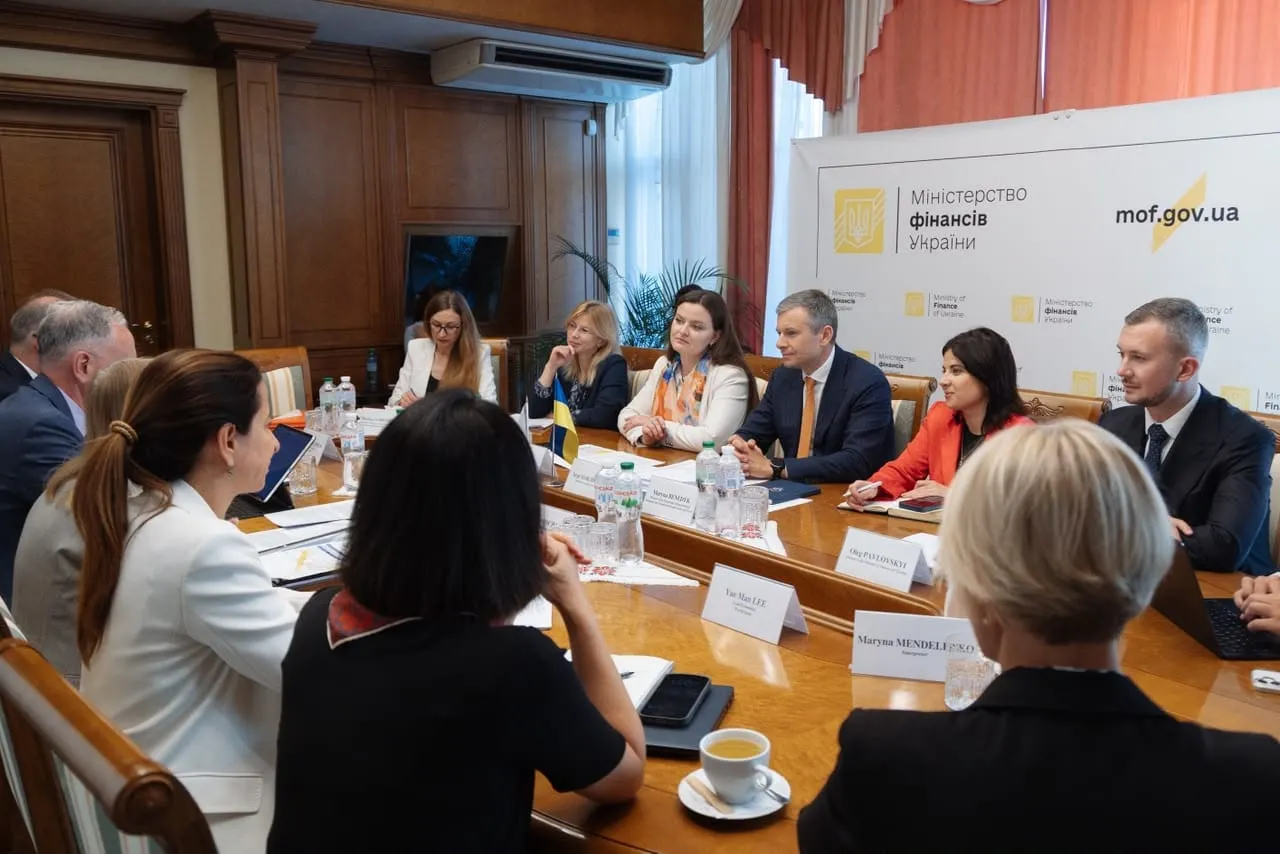
The Council of Europe Development Bank (CEB) has approved a €200 million loan to support 2 million internally displaced persons (IDPs) in Ukraine, the Ministry of Finance of Ukraine said in a press release.
The allocation will finance state budget expenditures for cash assistance to internally displaced persons, with the aim of ensuring their social adaptation and integration in new communities. The payments will include temporary accommodation, physical rehabilitation, free meals for IDP children in education, and assistance in joining the labor market in new communities.
"Together with the CEB, we have already successfully launched two socially important projects to restore the right to housing and healthcare, and received the first payments under them," said the Deputy Minister of Finance Olga Zykova.
"The implementation of a new initiative to support internally displaced persons in Ukraine will help to provide more than 2 million Ukrainians with the necessary assistance," Zykova added.
The project is the third CEB operation in Ukraine since the country officially joined the bank in June 2023, bringing the total amount of approved financing to the country to €400 million.
The other projects include the €100 million "HOME: Compensation for Destroyed Housing," which focuses primarily on housing construction and reconstruction sector. As of November, the project financed 1,741 housing certificates, allowing citizens to purchase more than 1,400 properties.

The Guardian: Russia's latest attack on Ukraine signals end to war 'long way off'
Russia's massive missile and drone attack on Ukraine's energy infrastructure on Sunday signals that the end to the war appears a "long way off," the Guardian wrote in an analysis.
Despite behind-the-scenes indications that Ukraine might consider ceding some occupied territory for peace, Russia's demands seem far more extensive, potentially leaving Ukraine with no option but to continue fighting, even without US military support as Donald Trump takes presidential office, the Guardian's defense and security editor Dan Sabbagh wrote.
The success of such efforts is, however, uncertain, Sabbagh argued. While Ukraine managed to intercept or neutralize 85% of the missiles and 94% of the drones on Sunday, Russia demonstrated in the spring how alarmingly simple it was to disable entire power stations with missile barrages when air defenses were stretched thin, he wrote.
Sabbagh also cited the Kremlin's statement following a call between the German Chancellor Olaf Scholz and Russian President Vladimir Putin on Friday, which suggested nothing had changed in Russia's negotiating position, and that its full-scale invasion of Ukraine was the "direct result" of a NATO policy that aimed at "creating a staging ground against Russia on Ukrainian soil."

Ukraine's job seekers report limited job availability, low salaries as top challenges, IOM research shows
Job seekers in Ukraine see a lack of local job opportunities and low salaries as the main challenges they face in the labor market, research conducted by the International Organization for Migration (IOM) revealed.
Limited job availability was highlighted by 39% of respondents in rural areas, compared to 28% in major cities, showcasing the weaker labor demand in rural regions.
In the analysis of the so-called "silver economy," which specifically explores employment opportunities for individuals approaching retirement age, the research found that individuals aged 55-59 encounter significant age-based discrimination and have lower employment rates than younger age groups.
The research also found that, while insecurity remained the main cause of displacement, employment significantly influenced movement within Ukraine for both internally displaced people (IDP) and returnees.
Notably, the lack of job opportunities was the top reason cited by returnees for leaving their previous location (31%). This was reported by 41% of respondents returning to the Donetsk region and 39% returning to the Zaporizka region, highlighting that livelihood-driven returns occur in severely conflict-affected regions.
In August 2024, the estimated employment rate in Ukraine among working-age (18-60 years old) respondents was 67%, representing a decline of 6 percentage points compared to the situation before the Russian full-scale invasion in February 2022, with IDPs being the most affected by the decline in employment, according to the IOM.


Social media posts, particularly on LinkedIn, are dominated today by organizations and indidividuals recounting their experiences and contributions to the ReBuild Ukraine even in Warsaw, with posts from:
- AHK Ukraine offering its highlights
- Vitalii Opryshko, senior adviser at the British Embassy in Kyiv, detailing the activities of the UK delegation
- Adam Mycyk, partner at Denton's in Ukraine, recapping developments at the even linked to the Ukraine Investment Framework
- Ukrhydroenergo, the state hydro power generator, posted about its meetings with the German government's state-owned bank Kreditanstalt für Wiederaufbau (KfW) at the event
In other social news ...
Tyson Barker, deputy special representative of the US for Ukraine's economic recovery, recapped the visit by Richard Verma to Warsaw and Kyiv over the past week, plus the revision the the "travel advisory from level 4 to level 3 for 9 regions in Western Ukraine based on war risk data."
The Ministry of Economy of Ukraine posts that special representatives for the restoration of Ukraine from 19 countries met in Warsaw to discuss "development of trade and export potential of Ukrainian processing enterprises, improving the regulatory environment for business and production insurance."