A Swiss project preparation facility created to back municipal-level projects in Ukraine is looking at subway extensions, overpasses, electric buses, urban transport rehabilitation and other infrastructure to back with Swiss assistance, the project leader said.
Mario Ortner, operational lead of the CHF 21 million facility, said the projects under consideration are in both eastern and western Ukraine, although the facility is prioritising projects away from frontlines.
The Swiss-Ukrainian Municipal Project Preparation Facility (PPFforUkraine) is part of Switzerland’s CHF 5 billion commitment to Ukraine’s recovery for 2025–2036, with CHF 500 million earmarked specifically to mobilise the Swiss private sector by 2028.
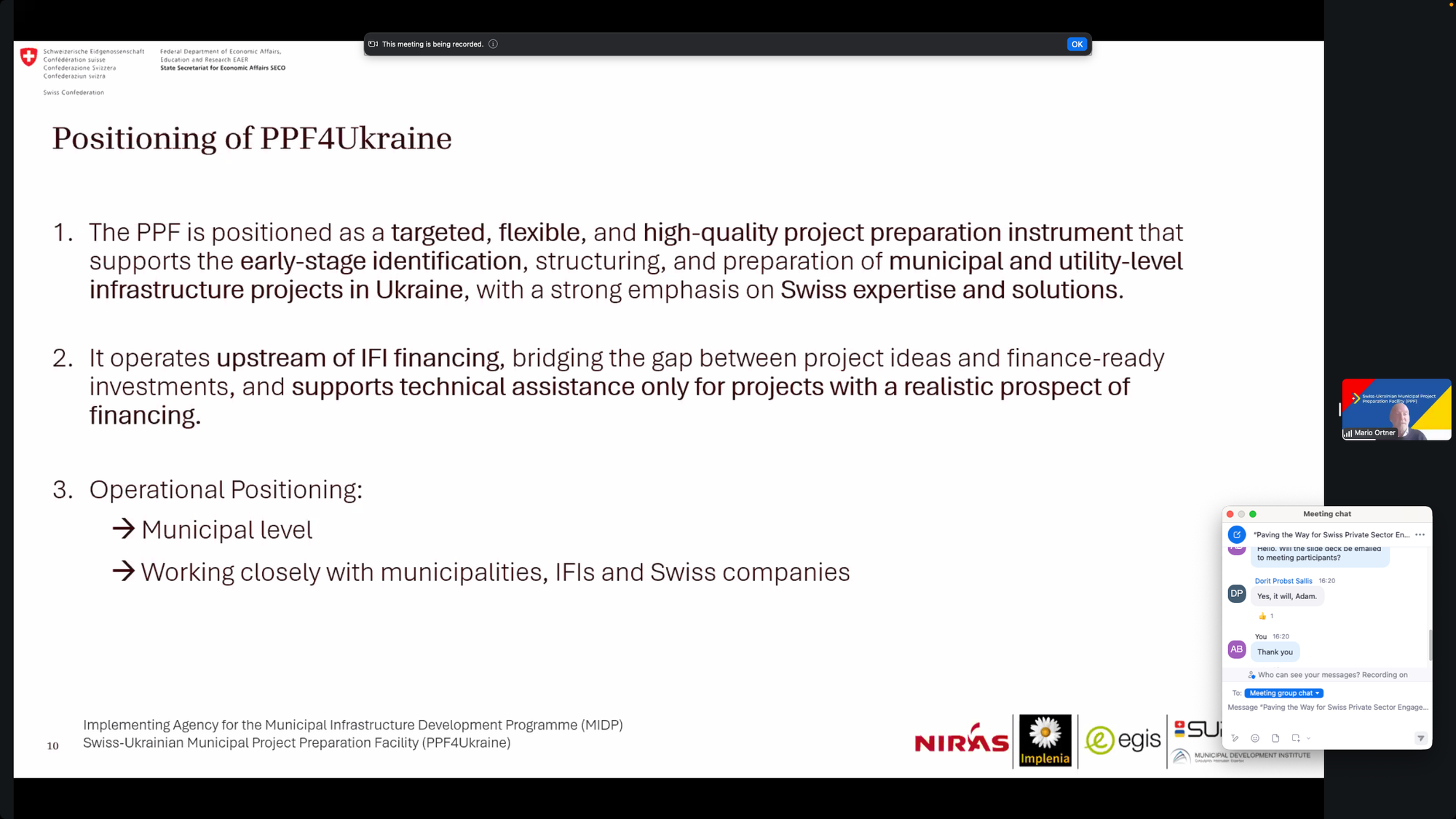
Ortner said the PPF itself runs for five years and is designed to turn municipal project ideas into bankable, finance-ready investments that can attract lending from international financial institutions.
He added that the PPF funds early-stage project preparation—concept design, feasibility studies, environmental and social assessments and permitting—only where there is a realistic path to external financing.
“We support technical assistance only when there is a realistic chance that the project can be financed," Orter said. "Before we spend money for technical assistance services, we need cooperation with the loan financer… a memorandum of understanding or a letter of intent with this IFI."
“We do not jump into technical assistance if we don’t see the light at the end,” he said, adding that the facility seeks early engagement from lenders such as the European Bank for Reconstruction and Development or the European Investment Bank before committing funds.
Projects are sourced primarily from Ukraine’s national DREAM digital platform, which forms part of the country’s public investment management reform and serves as a transparency and prioritisation filter for donor and IFI funding.
Urban transport, energy efficiency, district heating
The PPF focuses exclusively on the municipal level. Maryna Denysiuk, deputy minister at the Ministry for Communities, Territories and Infrastructure Development of Ukraine, said at the webinar that more than 10,000 projects sit in local pipelines, compared with roughly 200 at national level.
Priority sectors for the PPF4Ukraine include urban transport, energy efficiency in public buildings, district heating, renewable and distributed energy such as biogas and combined heat-and-power plants, as well as water and wastewater systems.
The Swiss contribution is expected to take the form of grant funding — around 20% of project costs — used to close bankability gaps and unlock significantly larger volumes of IFI lending.
The webinar drew a live audience of about 120 viewers, including representatives from Swiss companies, Ukrainian government officials and others.
The Q&A session focused on practical execution constraints — how projects enter the pipeline, how financing is secured and gated by IFIs, how procurement and grants interact, what geographies are feasible given security risk, and what risk-mitigation tools are actually available.
Access event audio and AI-generated transcript at this link
Webinar Metadata
- Title: Paving the Way for Swiss Private Sector Engagement in Ukraine’s Reconstruction in the Swiss-Ukrainian Municipal Project Preparation Facility (PPF)
- Date: 15 January 2026
- Time: 15:00–16:00 CET
- Format: Online webinar
Organisers
- Swiss-Ukrainian Municipal Project Preparation Facility (PPF)
- Swiss State Secretariat for Economic Affairs (SECO)
Key Speakers
- Jacques Gerber — Federal Council Delegate for Ukraine, Government of Switzerland
- Mario Ortner — Team Leader / Operational Lead, Swiss-Ukrainian Municipal PPF
- Deputy Minister for Communities and Territories Development of Ukraine — representing Ukraine’s reconstruction and municipal investment policy
- Senior representative, Implenia — consortium partner, Swiss construction and infrastructure group
Implementing Consortium
- NIRAS (lead consultant)
- Implenia
- Egis Ukraina
- with SURA (Swiss-Ukrainian Reconstruction Agency) and the Municipal Development Institute (MDI) Ukraine as subcontractors