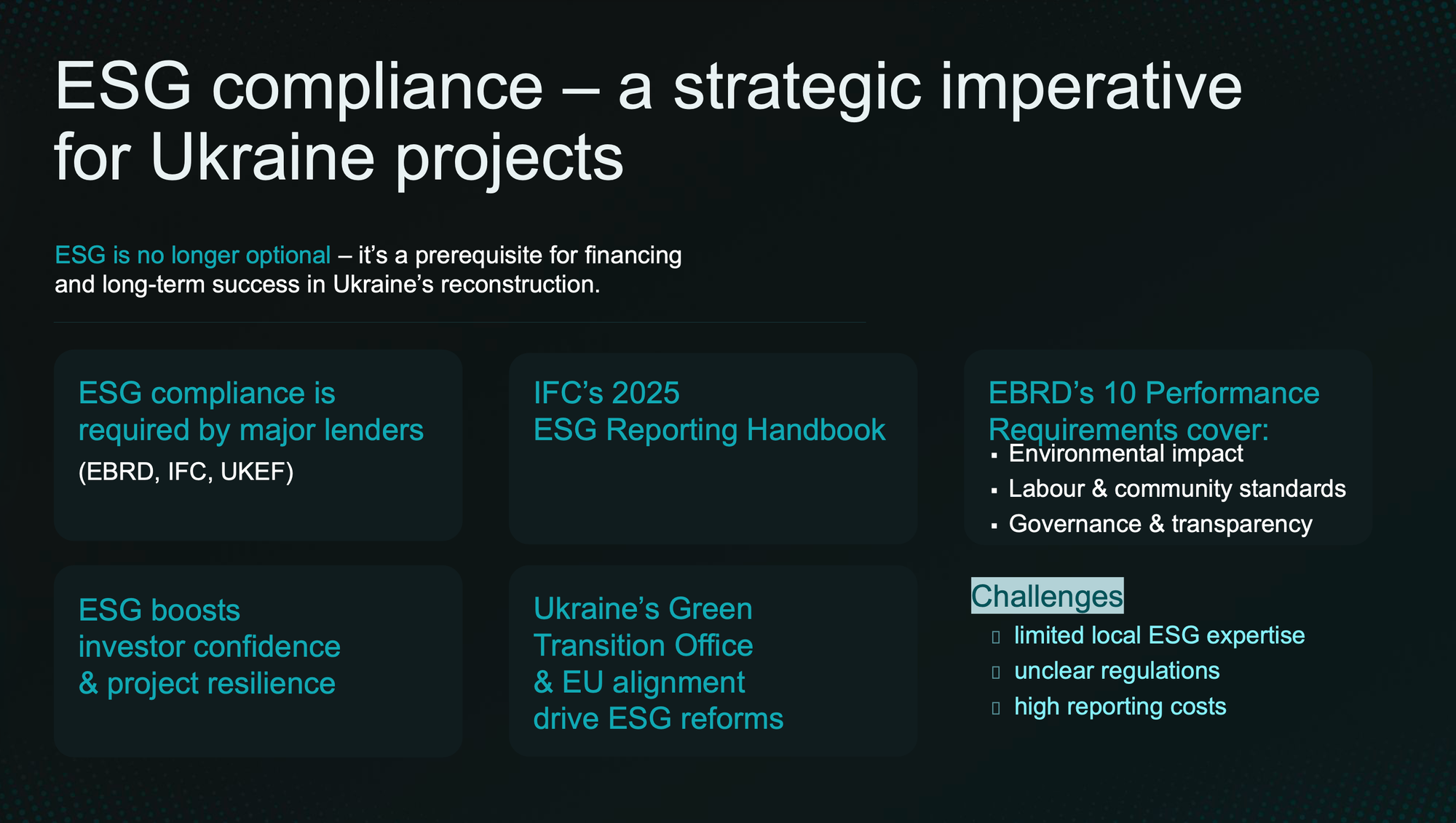
Although ESG requirements are being questioned politically in some parts of the world and some Ukrainian companies downplay their relevance, they remain a firm requirement for international firms seeking to invest in the country, legal advisers said at a business webinar this week.
International companies looking at Ukraine are often met with skepticism from local partners struggling to survive the war, Yaroslav Petrov, a partner at Asters, said during a Jan 27 webinar hosted by the Ukraine Britain Business Council (UBBC).
“There is a war in Ukraine! What ESG standards are you talking about?” Petrov said, describing a reaction he said foreign investors frequently encounter. “These are especially the kind of comments you may hear from Ukrainian companies.”
Petrov said many local firms are focused on basic survival, including securing electricity and keeping production running, but that this does not change the expectations of international lenders and partners.
Companies struggling to survive
“Many of them suffer and try to get electricity for their production, etc. But the reality is that ESG is still on the table,” he said, adding that international banks continue to require compliance with governance, social and anti-corruption standards as a condition for financing.
"Whenever you look into international financing, you will find issues related to ESG," he said.
Petrov said large international lenders apply ESG requirements consistently, and Ukrainian banks are increasingly aligning with those standards. He also warned foreign companies that compliance failures can carry cross-border legal risks, citing the extraterritorial reach of the UK Bribery Act.
Transparent procurement, gender action
He gave several examples of ESG requirements foreigners may face:
- The EBRD has been giving loans with a specific requirement that the borrowers ensure transparency of procurement procedures, mostly by using the Prozorro procurement system, he said.
- A €75 million loan agreement for state-owner power producer Ukrhydroenergo signed in January required the state-owner power producer to enact a gender action plan and professional development training for employees.
"Large private banks are also following this trend, looking into the projects and putting in place these requirements," he said.
Petrov spoke at a Jan. 27 supply-chain assurance webinar hosted by the Ukraine Britain Business Council, which examined how companies can manage risk as Ukraine prepares for a long-term reconstruction effort.
Other speakers said execution and counterparty risk remain key challenges for investors. Tony Chattin of MSS Global said companies should not rely solely on price or paperwork when selecting suppliers, urging the use of certification checks and other verification tools to assess counterparties.
Bankers also pointed to sustained international interest in Ukraine despite the conflict. Alexander McWhorter of Citibank said foreign investors remain focused on sectors with clearer governance and fewer legacy monopolies, adding that a U.S.-backed investment fund is open to non-U.S. suppliers if they can demonstrate returns and compliance standards.
Ihor Olekhov of CMS said companies can reduce legal risk by structuring contracts around arbitration and foreign dispute resolution, rather than relying solely on Ukrainian courts.
For the full audio and a machine-generated transcript of the webinar, click here.
Download the slide presentation of Aster's Yaroslav Petrov below:
Download the slide presentation of CMS's Ihor Olekhov below:
Contact details for participants:
Aster Partner and London Office head Yaroslav Petrov - yaroslav.petrov@asterslaw.com
CMS's Ihor Olekhov - ihor.olekhov@cms-cmno.com
Citi Country Officer Alexander Mcwhorter - alexander.mcwhorter@citi.com
MSS Global Director Tony Chattin - tonychattin@mssglobal.com
Webinar host Ashley Goodall of the Ukraine Britain Business Council - a.goodall@ukrainebritainbusiness.org
Webinar details (CMS):
Title: Supply Chain Assurance in Ukraine
Date: Jan. 27, 2026
Host: Ukraine Britain Business Council
Format: Webinar / panel discussion
Attendees: About 40
Key speakers:
- Yaroslav Petrov, Asters
- Ihor Olekhov, CMS
- Tony Chattin, MSS Global
- Alexander McWhorter, Citibank
Topics: ESG and compliance requirements, supply-chain due diligence, dispute resolution and arbitration, investor risk management in Ukraine